
1944
- Max Cardozo
- Jul 29, 2021
- 9 min read
Updated: Dec 1, 2021
Around March 1, 1944, I have moved away from the Koopmans' farm to live with Harm de Roos, a postman who lived in Benningbroek with his wife, Nel. The de Roos family had a pig, and I became good friends with this pig. I used to wash him and ride him around, wearing Uncle Harm's postman cap. Then, one sad day, I had to say goodbye to my friend the pig—who graduated from being a family pet to a family dinner. In general, Uncle Harm de Roos was terrific to me—he seemed to love me as a son of his own.
But Nel, I'm sad to say, was not very kind to me at all. I don't know why. When Uncle Harm was not around, it always seemed I was being punished for some trivial reason—even for just talking, she'd punish me. I thought she hated me. Maybe she just resented me for making her life needlessly difficult. I cannot write much about this. For so many years, I've had it hidden inside, and it still hurts. Suffice it to say that my experience of living with the de Roos family had gone utterly rotten by the end of March.
On April 1, the de Roos moved me back to live with the Koopman family. Annie Koopman was so happy that I'd returned; she made it a true celebration. She even baked me a cake. I was delighted to be back, too. I even decided to try and get along with Sjaak Veerman.
In that year, 1944, I began to see something new in the skies over West Friesland. It came across the horizon, sounding like a train over the roof, with a fireball at its tail. I later learned this was called a "V1" or "buzz bomb." It was a bomb with wings, a rocket engine, and no pilot. When the motor on the V1 stopped, there was trouble. Day and night, I saw and heard flying bombs, falling bombs, bombers, and fighters both rising and falling. They scared the pants off me, and sometimes worse.
During the day, the buzz bombs could be seen, tracked, and shot down by antiaircraft gunners or fighters. Sometimes, the pilots would get so close; they could place their wing-tips right under the buzz bomb's wing; then, by gently tipping a wing, they could upset the V1's gyroscopic guidance system, sending it out of control. When that happened, you'd better hide. Over ten thousand V1s were launched from sites near where we lived, of which two thousand came wildly careening back down again, dropping into the farm country. After a while, the Germans got smart and started launching V1s at night, when they were harder to knock out.

Then there were V2s. You couldn't hear them coming at all because they flew faster than sound. That was a whole new kind of terror, for which the human mind had no ready response except a sort of fatalism. Airplanes would cover the skies. Smaller "Mosquito" bombers made low-flying raids on anything that moved and looked Nazi. We would see black pillars of smoke in the sky when they hit their targets.
On May 12 alone, 886 bombers and 735 long-range fighters flew over us on their way to Germany. That day, the Americans lost forty-six planes, the Germans fifty-six.
Late in the war, the Allies had "Thunderbolt" fighters equipped with extra fuel tanks to increase their range. The fighter pilots would jettison their different tanks before going into action, and these tanks would often drop into our fields. Below is the farmland that would retrieve the drop tanks and use them to make baking pans and other containers.

June 6, 1944, was the day the great invasion finally began. They called it D-Day. Aunt Cor hung the Dutch flag on the clothesline upsidedown that day.
On June 28, 1944, an American airman, whose name turned out to be Frank A. Hart, crash-landed his B-24 in Obdam, just a town or two over from us. Right away, the whole Nazi organization in West Friesland was on the move, searching for him. It was about eight o'clock in the evening when the trucks stopped in front of our farmhouse, loaded with SS men and their dogs. Panic. First, the Nazis went straight back to the barn. Annie Koopman got busy pulling up the planks of the platforms inside our bedstee bed.
At the Koopmans' farmhouse, we'd had a group of wounded RAF flyers, some of whom were still there—and there had been blood all over the floor. Surely the scent would lead the SS dogs directly to their prey. Fortunately, Kees Koopman had had the forethought to sprinkle some cow urine around, to try and confuse any German shepherds that might come our way.
The SS men had taken up our pitchforks in the barn and were stabbing around in the hay. But all they found was the cheese we had buried there to make it age faster. I jumped into bed with Annie Koopman. My heart was pounding like a pile-driver. Presently, we heard the Germans stomping into the front room with Aunt Cor. The door to our bedstee jerked open—and there were the SS men, looking me straight in the face. Well, this is it, I thought. They've got me. I think the dogs must have smelled something in the back because abruptly, they all turned about and left the room.
I don't know who was shaking harder at this point, Annie or me. A while later, we heard they were gone, and the coast was clear. We threw back the straw-filled mattress and began pulling up the planks again. Hiding silently in the crawlspace below, all this time, were Sjaak Veerman, his wife, his mother—and our guests from the RAF. Still shivering, I crept into the other bedstee, closed the door, and dove straight to sleep. The following day, I went with Piet and Wim to milk the cows.
One summer day, when I was living with the Koopman family—in July or August 1944—I don't know what precisely triggered it. Still, I grew so depressed that I just ran out into the fields, ran about a mile behind the house, and lay down on the ground, weeping inconsolably.
After maybe half an hour, maybe more, I sensed a presence blow over me in the muddy grass. Then, I felt some huge, fierce, moist thing at the back of my head. The cows had slowly gathered around and were licking me. I can only think they were trying to comfort me, just as I sometimes wanted to settle them. After a while, I got up again and walked back to the house.
September 5, 1944, would later become known as Dolle Dinsdag—Crazy Tuesday. That was a strangely quiet weekday when the German presence had begun to seem so diminutive, so invisible in places, that many Dutch citizens got the wrong idea. Rumors of the Nazis' capitulation spread across the country, snowballing in conviction—until, in some towns, people even began hoisting the Dutch colors in celebration. But the Nazis, thought they might be, were far from gone—and they soon put an end to the misguided festivities. The worst was still to come.
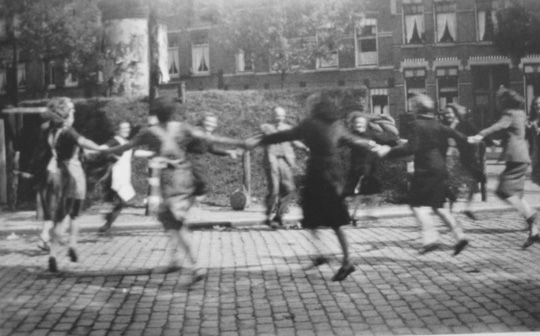
The winter of 1944-45 is remembered in Holland as the Hunger Winter. By now, for the Germans, the dream of a thousand-year Reich had evanesced, and with it the hope of ever permanently annexing Holland as the bountiful western shore of Greater Germany. The Germans began to withdraw—carefully, slowly, bitterly—leaving behind only a dwindling rear guard and enough specialized squadrons to keep launching their overstrung waffen into the sunset. These "vengeance weapons" were aptly named. For a while, the V1 and V2 missiles could no more redeem the German cause than they could change the direction of the wind; at least they could wreak punishment.
But that was all the Nazis left behind. They took every valuable thing that wasn't anchored in stone with them—including all the food stores. Sometime that fall, our queen had called over the radio for railway workers to strike. That would weaken the Nazis and hasten our liberation.
But striking was treason and a dangerous undertaking. The Nazis responded by simply leaving the railways shut down, except as manned by their soldiers for their use. The same went for barge canals, gas, coal, and electricity. Whatever resources were left after the Nazi plunder had no way of getting to the cities. The Dutch began to freeze and starve, precisely what the Nazis had in mind for us—ingrates that we were.
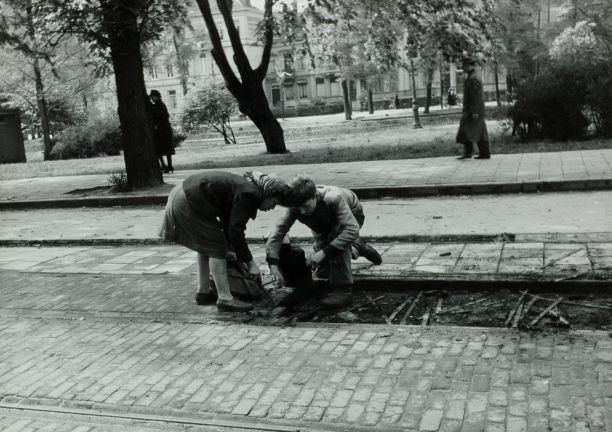
Long, abnormally cold spells compounded the crisis. The bitter, merciless frigidity hit everyone hard across Holland—but we up in the farmlands were far luckier than those cut off in the cities. In Amsterdam, people were boiling tulip bulbs to try and get some nourishment; once there was no more coal to steal for fuel, they tore up the ties under the tram tracks for firewood. The deserted Jewish houses in the old Jewish Quarter were now ransacked for wood to burn, and many buildings collapsed. Our cheery, egalitarian Dutch civilization had come down to this. It was dog-eat-dog. By December 31, 1944—another Ouderjaars Avond, or New Year's Eve—the Hunger Winter was reaching its nadir of desperation. That day, I would get into big trouble.
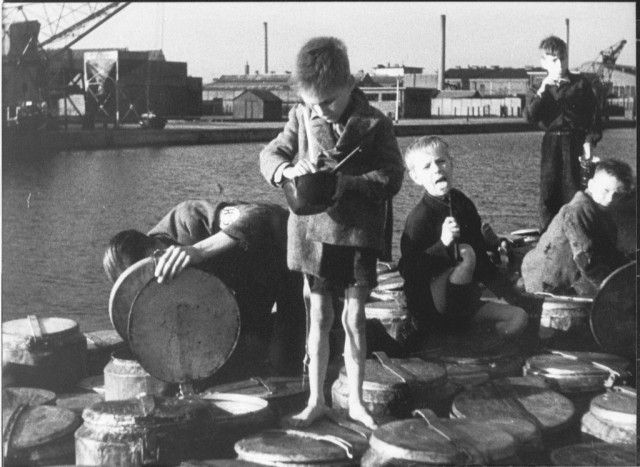
It was a Friday morning, about 11:00. When I went to the window and looked outside, I saw people—people by the hundreds—trudging along the road past the Koopmans' house. It was as if I were staring into a nightmare. I dare to call them people, but they looked just like walking skeletons, in torn-up clothing, some lucky enough to have rags wrapped around their feet. There were children, maybe five or six years old, and many people who must have been in their forties but who looked seventy or eighty. Some were wheeling pushcarts; some used bicycles with no tires to carry their bundled belongings.
I didn't know where they were all coming from, this endless stream of dispossessed souls, none of whom seemed to have eaten for days. I was all twisted up inside. I wished I could do something for them, but I knew I mustn't. Even at my age—just shy of seven—I clearly understood that any intervention from me would endanger not only my protectors, the Koopmans but the three other secret Jews hiding under their roof as well. We'd had enough close calls already. To draw any new attention to our household might mean a death sentence for us all. So, I stood at the window, determined to be a silent witness. That terrible, steel rationality prevailed in my young mind.
Until the moment I saw my Oma Betje's face passing in the crowd. Then it all unraveled, quick as a string, letting go a top. Maybe seconds later, a minute, there I was outside, hauling with me a can of milk, a few potatoes, and all the bread I could find in the house. I was only seven, so I could only carry so much.

No sooner was I in the road than the starving people began to crowd around me. As I started giving out my food, the people asked me, "Whose boy are you?" "Where do you come from?" "What is your father's name?" I was looking this way frantically and that for my Oma, but she was nowhere to be seen. Where had she gone?
Then, there were hands on my shoulders. Piet Koopman had run out to grab me. He picked me up and carried me back to the house, against my protests—leaving inferior Aunt Cor to try and quiet the crowd and persuade them to move on. We had no more to give.
Sitting inside the house, defeated, discouraged, I waited now for the Nazis to come to take us all away in their cattle cars. I was so sure I'd seen my Oma's face out there. Why was everyone so sure I was wrong? Then, Annie came to get me. She needed my help; one of the cows was trying to give birth. She took me back into the barn.
It turned out that there was more trouble to come that day. The calf was turned around backward inside the cow's body. There was no way for there to be a normal birth. Piet came back to help. Between him, Annie, and me, we pulled and pulled on the calf. But it became clear we would fail. The calf was doomed. If we didn't get him out somehow, the mother was convicted as well. We had to make a choice: who would live, who would die. Piet got the saw.
I ran to the front of this great, big screaming cow. I pushed the water bucket in front of her, splashed water on her forehead, petted her head and spoke to her, and tried to comfort her while poor Piet had the horrific task of dismembering the doomed calf alive.
One had to die that the other might live. Why did life have to be this way? It was all like a horrible dream, reaching out to grab me, trying frantically to tell me something, to mean something. But it was no dream. I began to cry.
Aunt Cor came and took me in her arms and brought me back to the front room. But I found no comfort there, as Sjaak Veerman roundly reprimanded me for endangering the whole household that day. Then, Annie came in, blood all over her clothes, and seeing what was going on; she jumped all over Sjaak. "Where were you when I needed help?" she demanded to know.
On November 27, Oma Betje had sent us a postcard before she knew of her destiny. Before lunchtime, she was rushed into a depressing series of train rides. The trains had bare, unpainted freight cars in the front and proper coaches for the guards in the back. Some vehicles had newspapers on the floors; these were for the sick. Oma Betje's postcard said that she was at Hannukah camp in Westerbork. She said she had received her first parcel and that she would divide it with the camp's children. But in reality, she was in Barak 66, a village of wooden barracks, set between earth and sky, full of dead weeds, with black dirt, in the middle of nowhere, and barbed wire all around. \

The Red Cross reported that Oma Betje was murdered in Auschwitz on December 4, 1942. She could not have been on the first day of Hanukkah camp in Westerbork to everyone's heartbreak.

Comments