
Do Christians and Jews Face Another Catastrophe
- Max Cardozo
- Jan 11, 2022
- 22 min read
Updated: Feb 3, 2022

We were all taxed, robbed, beaten, arrested, and jailed for no reason other than for the fact that we practiced our religion. And we were shipped off to labor or concentration camps. Adolf Hitler and the Nazis seduced a nation, bullied a continent, and attempted to exterminate the Jews of Europe.
We have seen brave people willing to stand up to their oppressors and fight against them throughout history. Who better to face the greatest evil of the 20th century than the humble man of faith Rabbi Menachem Mendel Schneerson (April 5, 1902 – June 12, 1994). Known as the Lubavitcher Rebbe or just the Rebbe, he is considered one of the most influential Jewish leaders of the 20th century. Schneerson made it his mission to rebuild Jewish life after the devastation of the Holocaust, reverse the Communist eradication of Judaism in Russia, and combat widespread assimilation by encouraging Jews to engage more deeply with their faith. By preaching a non-judgmental love for all humanity and claiming that everyone is equal to God, he inspired his followers "to reach out in love —and without fear"—to all kinds of people.

Israeli Prime Minister Menachem Begin (right) with the Lubavitcher Rebbe, Rabbi Menachem Mendel Schneerson, in Brooklyn, N.Y. Photo by Yaacov Saar/GPO.
Dietrich Bonhoeffer was a pastor and author. His life is a searing story of incredible moral courage in the face of monstrous evil. He chose to leave America and return to Hitler's Germany, and he was involved in the Valkyrie plot and in "Operation 7," which was a plan to smuggle Jews into neutral Switzerland.
Bonhoeffer was a Christian theological worker who prepared young seminarians for parish work. He and his seminarians were under Gestapo surveillance. Various accounts shed light on Bonhoeffer's active resistance to increasing involvement in the conspiracy against the Hitler regime. He was subsequently arrested, and he faced long imprisonment. His exchanges with his family, fiancée, and closest friends demonstrate the affection and solidarity that accompanied Bonhoeffer to his prison cell, concentration camp, and eventual death.
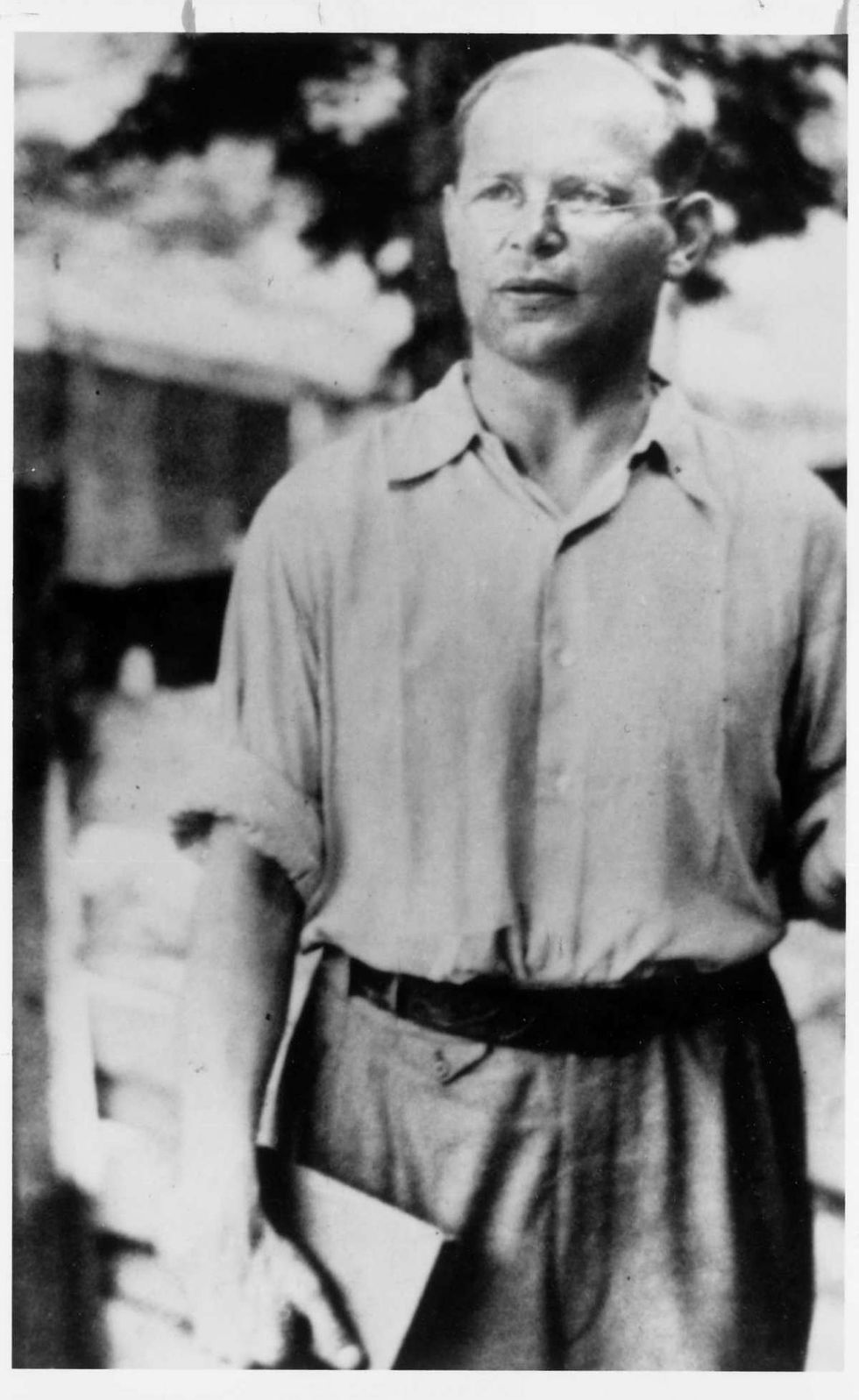
Dietrich Bonhoeffer was a German Lutheran pastor, theologian, anti-Nazi dissident, and key founding member of the Confessing Church.
We may need such brave people again. Christians and Jews rarely anticipate the catastrophe that could be on the horizon. It's only in retrospect that it inevitability makes sense. This puzzle is the issue I have addressed over the past few years in my three books—a child underground, published in 1989; DO NOT REPEAT CATASTROPHE, published in 2013; and my third book, now in manuscript form and almost ready for publication.
Christians and Jews never saw the catastrophe coming until Hitler made his intentions clear, three years after his party won the 1932 election freely and democratically. Party affiliation: Nazi Party and now the hijacked Democratic — the network of big money, ex-Clinton political operatives, unions, and left-wing grass-roots organizations that now essentially control the Democrat Party.
How did George Soros, Hillary Clinton, and Sixties radicals seize control of the Democratic Party," i.e. influential Americans secretly stirring up disunion and disloyalty in the shifting shadows of the Democratic Party." A long-ago radical Marxist (now the tireless and articulate conservative nemesis of the Left), now a columnist, states how the new hijacked party is a George Soros conglomerate. George Soros, a billionaire, has engineered campaign finance reform by pouring tens of millions of dollars – and getting others to do it too – into the campaign finance reform movement. This is done because it limits the ability of the political parties to raise money. As soon as the campaign finance laws came into place, they had a loophole — and naturally, they would, because Soros was behind it – for private organizations like MoveOn.org, called 527s, that could collect money.

George Soros HonFBA (born György Schwartz, August 12, 1930) is a Hungarian-born American billionaire investor and philanthropist.
Soros created a coalition (the new hijacked party), which accounted for about $300 million in the Democratic campaign. It was much more than that. He put together a group that orchestrated media ads. He even chose the democratic nominee, who was able to shape the message of the John Kerry campaign and, in effect, control the direction of the party.
But through another organization, Americans Coming Together, they put together the ground war. ACT was composed of big government unions, like SEIU and related teacher unions. They could produce 100,000 campaign workers and vast amounts of money to knock on doors and get out the vote. Because Soros and his funded groups put together both the ground and air war of Democratic campaigns, this meant that every elected Democratic official needed to pay careful attention.
First of all, one must understand who Soros is, as he is portrayed in many ways, including philanthropist and capitalist. He says that the capitalist system has replaced communism as our greatest threat. Second, he stated that America is the greatest obstacle to world justice and stability. His plan is to “burst the bubble of American supremacy."
We've also described the radical components of the Soros operation. This is not something you talk about merely in electoral terms, as if it’s simply a typical special interest group coming together. At its base, this is a grass-roots movement that has bankrupted the city of New York, which was done by loading the welfare rolls. The core of this was named the National Welfare Rights Organization, and their strategy was to recruit people to the welfare system in order to break it. Yes, Soros put this together. He has brought together elements of philanthropy, political, business, union, and the world of radical street politics, creating a juggernaut.
This is the essence of the Democrat Party, as no Democrat can be elected without it. He has allied himself with Hillary Clinton and the Clinton team, later called the Center for American Progress, which is run by Clinton's former chief of staff, John Podesta, while there is an entire constellation of organizations around that solidifies his power. So, no other center of power is significant in the Democratic Party anymore.

The Center for American Progress is a public policy research and advocacy organization which presents a liberal viewpoint on economic and social issues.
While there are right-wing Republicans who try to influence elections and get bills passed, etc., what makes this more sinister than what the Republicans or right-wingers do?
First off, it is much more organized. There are apparent constituencies in the Republican coalition, who have different agendas, but they compromise. Here, however, you have a portion of a party that is not visible. Very few Democratic voters even know this exists. It's working behind the scenes, and its agendas are radical in a way that no Republican constituencies are. In the end, they compromise, and so they vote.
"I have made a good faith attempt to address your concerns. Still, since your theories are based on limited and misinterpreted information, and you seem to be convinced of a conspiracy or ill intent on our part, this will be my last email to you on the subject."
Jean Zeldin
Executive Director/CEO
My email to Jean Zeldin was as follows:
I came to America, not as a holocaust survivor, but as a “never again” person, I joined the U.S. Army to thank the thousands of Americans who saved our lives, and now I see how groups like yours are poisoning the youth with the aid of a self-destructive Jew like George Soros,
The antisemitism did not start under the black slaves with deformed noses as they showed you pictures in your presentation showed.
I chose the party of Lincoln and became more disappointed as time went on; Lincoln had it right and should have maintained this as the party for all Americans.
Antisemitism was an import from Germany.
With the funds you receive, it is your job not to listen to George Soros.
Here are the top 10 Reasons George Soros is dangerous:
1. He gives billions to left-wing causes: Soros started the Open Society Institute in 1993 to spread his wealth to progressive causes. Using Open Society as a conduit, Soros has given more than $7 billion to a who's who of left-wing organizations. This partial list of Soros' money recipients says it all: ACORN, Apollo Alliance, National Council of La Raza, Tides Foundation, Huffington Post, Southern Poverty Law Center, Sojourners, People for the American Way, Planned Parenthood, and the National Organization for Women.
The 2004 Take Back America Conference held in Washington marked a watershed. It was the first time that Hillary and Soros had appeared together on the same stage at any public, mass-media event on U.S. soil. Until June 3, 2004, Soros and Hillary had gone to great lengths to conceal their collaboration from the public eye. They let the cat out of the bag at the Take Back America conference. The respect and affection they felt for each other were entirely on display.
Hillary introduced Soros to the audience with these words: "Now, among the many people who had stood up and said, 'I cannot sit idly by and watch this happen to the country. I love George Soros, and I have known George Soros—(applause)—for a long time now. I first came across his work in the former Soviet Union, when I was privileged to have traveled there. Both on my own and with my husband on behalf of our country. [W]e need people like George Soros, who is fearless and willing to step up when it counts. So, please join me in we!-coming George Soros."

George Soros and Hillary Clinton..
Soros' speech touched on many issues, but the most instructive was his comments on the abuses at the Abu Ghraib prison in Iraq. Soros said, "I think that the picture of torture in Abu Ghraib, in Saddam's prison, was the moment of truth for us, . . . I believe that those pictures hit us the same way as the terrorist attack itself, not entirely with the same force because in the terrorist attack, we were the victims. In the pictures, we were the perpetrators; others were the victims. But, there is, I'm afraid, a Direct connection between those two events, because the way President Bush conducted the war on terror converted us from victims into perpetrators.", The audience of Democrats burst into applause at these words.
At the beginning of his speech, Soros had praised Hilary with warmth and admiration that seemed every bit as sincere as hers: "I'm very, very proud to be introduced by Hillary. I've seen her in operation. I have great admiration for her. I've seen her deliver a speech in Davos about an open society that explained the ideas better than anybody else that I've heard. I've seen her visit Central Asia, where I have foundations, and she was very effective, more effective than most of our statesmen in propagating democracy, freedom, and open society."

Hillary Rodham Clinton at the Annual Meeting of the World Economic Forum Davos, Switzerland February 2, 1998
Hillary had delivered the speech in Davos to which Soros referred at the 1998 meeting of the World Economic Forum in Switzerland. Soros and Hilary attended together. The Davos junket came as a welcome break for Hillary, and a chance to escape the mounting impeachment crisis then consuming the Clinton White House. Hillary's friendship with Soros deepened during that stressful period of her life. One source close to Hillary's inner circle states that Soros came to visit Hillary at the White House during the impeachment proceedings; a tense period when she was receiving only her most intimate and trusted friends.' Hillary counted Soros among her confidants at that point.
No details of their early friendship are publicly available, yet it is clear that Hillary has known Soros "for a long time”, as she put it. Hillary states that she first became aware of Soros in the former Soviet Union. On November 22, 1994, the Clintons feted the new Ukrainian President Leonid Kuchma at the White House. Press reports indicate that Soros attended the NCR dinner party. Hillary traveled to Central Asia in November 1997, visiting several of the former Soviet republics. Among the cities she visited was Bishkek, the capital of Kyrgyzstan, where she cut the ribbon for the opening of the American University of Kyrgyzstan and received its first honorary degree. In her acceptance speech, Hillary praised the work of Soros' Open Society Institute, which had funded the university.

BISHKEK, KYRGYZSTAN - NOVEMBER 12: First Lady Hillary Clinton receives an honorary degree from the newly opened American University in Kyrgyzstan during a tour through Central Asia on November 12, 1997.
In November 1998, Hillary also made a two-day trip to Haiti. She toured US-funded healthcare facilities for financial backers, George Soros and William H. Gates Sr., father to Microsoft founder Bill Gates. Beyond these slender facts, we know very little about the early years of their relationship. Neither Hillary nor Soros have written about each other in their books, and the Washington press corps have avoided any mention of their long and ever-deepening friendship.
One exception to this rule was a Newsweek report of May 11, 1998, which hinted that Soros may have offered Hillary a job with his foundation network. "Friends daydream about her [Hillary] becoming head of UNICEF, or even U.N. secretary-general. More likely, it was some global foundation, aided by friends of George Soros or World Bank president James Wolfensohn, who wrote Howard Fineman. Why did Fineman consider it "more likely" that Hillary might take a job with Soros than with the United Nations? Perhaps he was guessing. Then again, Fineman appears to have had access to excellent sources for his story. He shared a byline on the article with reporter Matthew Cooper, married to Mandy Grunwald, a close Hillary advisor, and personal friend.
Hillary may or may not have considered working for Soros, but if she had, she would have found the ideological climate of his Open Society Institute as familiar and gratifying. With few exceptions, the causes of Soros' champions are precisely those dearest to Hillary's heart, such as rationing health care, rolling back gun rights, and extending the voting franchise to convicted felons.
Hillary's radicalism is deep-rooted and fundamental, bearing the unmistakable imprint of her early mentor Saul Alinsky. Hillary met the Chicago radical through a leftwing church group she belonged to in high school: They stayed in close touch until Alinsky's death. Hillary's 1969 senior thesis at Wellesley College was a 75-page salute to Alinsky. It contained excerpts of his forthcoming book, Rules for Radicals, which he had allowed Hillary to read before the book's publication in 1971. Alinsky offered Hillary a full-time organizer job with his Industrial Areas Foundation upon her graduation. She declined only because Yale Law School seemed to provide a superior path for infiltrating the Establishment.
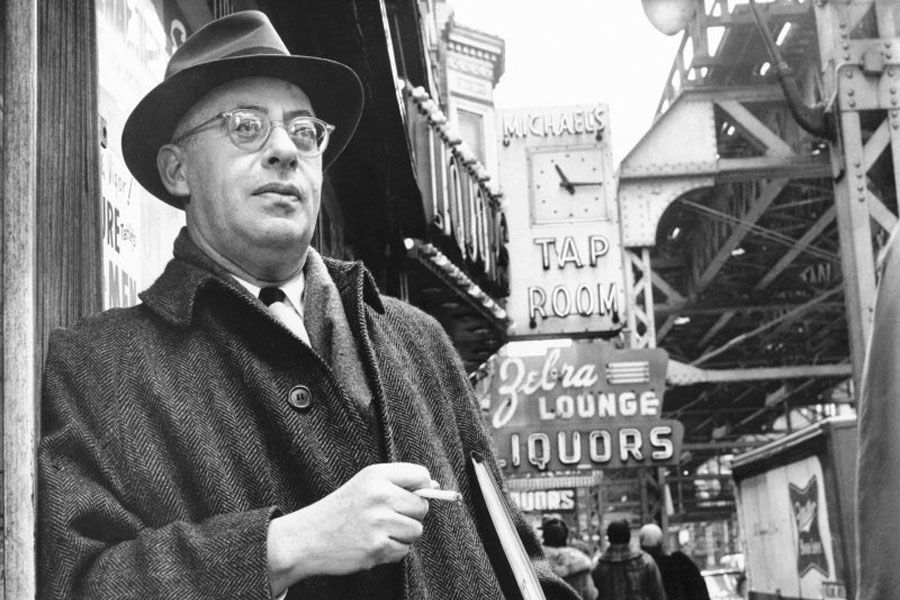
Saul Alinsky, the father of Community Organizing with a strong aversion to welfare programs, is pictured on a street on Chicago’s south side, on Feb. 16, 1966.
Hillary's efforts to cultivate a "moderate" or "centrist" public image faithfully reflect Alinsky's teachings. Alinsky pronounces a harsh judgment on the Sixties New Left in Rules for Radicals. Rather than winning over the masses, the New Left went out of its way to shock, horrify and alienate the groups he charged. He condemned flag-burning, Maoist slogans, and the chaotic hippie style. "If the real radical finds that having long hair sets up psychological barriers to communication and organization, he cuts his hair. . . . As an organizer, I start from where the world is, as it is, not as I would like it to be. . . . That means working in the system, ' Alinsky scolded."
Alinsky envisioned a unique role for white, middle-class activists such as Hillary, whom he saw as potential emissaries to the American heartland. "[E]ven if they organized all the low-income parts of our population—all the blacks, Mexican-Americans, Puerto Ricans, Appalachian poor whites—if, through some genius of the organization they were all united in a coalition, it would not be powerful enough to get significant, basic, needed changes,' Alinsky warned. Only by winning support among the white majority could activists hope to achieve "basic" change in America. Alinsky called for a proliferation of "middle-class organizations" and "middle-class guerrillas."'
He wrote:
“Action organizations will center upon America's white middle class now and the decade ahead. That is where the power is. Our rebels have contemptuously rejected the middle class's values and way of life. [l]t is useless self-indulgence for an activist to put his past behind him. Instead, he should realize the priceless value of his middle-class experience. His middle-class identity, his familiarity with the values and problems are invaluable for the organization of his "own people."”
Alinsky was a master of infiltration. He viewed revolution as a gradual—even orderly—process, best accomplished by infiltrating and manipulating institutions with deep roots in the community, such as churches, unions, ethnic organizations, and local political machines. In Alinsky's native Chicago, few institutions had deeper roots or wider influence than organized crime. The pragmatic Alinsky wooed gangsters as lovingly as he courted ward bosses, bishops, and school superintendents. Ironically, the city of Al Capone also happens to have given birth to modern, "liberal" criminology. Alinsky had a foot in both worlds. He pursued a master's degree in criminology at the University of Chicago from 1930 to 1932." U.C.'s radical sociologists defended and romanticized gangsters as victims of social injustice. Alinsky went even further, pursuing actual alliances with mobsters, befriending Frank Nitti, Capone's lieutenant.
Nitti had taken charge of Capone's empire after the mobster's imprisonment on tax charges in 1931. Minsky later boasted that Nitti "took me under his wing. I called him the Professor, and I became his student." In 1932, Alinsky married the daughter of a prominent Chicago bootlegger." He remained on friendly terms with gangsters all his life."
However, Alinsky's real power came not from the criminal underworld but Wall Street—specifically, the wealthy, "socially-conscious" patricians who funded his activism. A skilled fundraiser, Minsky managed to smooth-talk some of America's wealthiest philanthropists into underwriting his Industrial Areas Foundation—an organization dedicated to waging class warfare in America. He prided himself on his ability to "use the strength of the enemy against itself "—a strategy he called "mass jujitsu." "I feel confident that I could persuade a millionaire on a Friday to subsidize a revolution for Saturday out of which he would make a huge profit on Sunday even though he was certain to be executed on Monday," Minsky once quipped."
His early benefactors included department-store mogul Marshall Field III; Sears Roebuck heiress Adele Rosenwald Levy; and Gardiner Howland Shaw, an assistant secretary of state in the Roosevelt administration." Minsky's skill at seducing the rich ultimately brought him into the inner sanctum of American power, among the tight circle of Wall Street families whose influence can make or break presidents. One such kingmaker was Katharine Graham, an early friend of Minsky whose family newspaper, the Washington Post, would one day topple Richard Nixon." Graham inherited the Post from her parents, Agnes and Eugene Meyer. It was the Meyers who provided Minsky with the cash and publicity that catapulted him to national prominence in 1945." In 1944, the University of Chicago Press signed Minsky to write a book promoting his vision of a new American radicalism. Months before its publication, Agnes Meyer, co-owner of the Washington Post with her husband Eugene, lionized Alinsky and his movement in a six-part series titled "The Orderly Revolution." President Truman ordered 100 reprints of Meyer's series. By the time Alinsky's manifesto, Reveille for Radicals, hit the bookstores in January 1946, he was already famous. Reveille became a national bestseller, and Mrs. Meyer began funding Alinsky's Industrial Areas Foundation.

Eugene and Agnes Meyer, both half length., facing each other.
He learned to wield power quietly, below the radar. During the sixties, major media ignored him, yet Alinsky's hidden hand directed some of the decade's most potent insurgencies. The War in Poverty bureaucracy was filled with Minsky's acolytes. The infiltration began in 1961 when Robert Kennedy appointed Columbia University sociologist Lloyd Ohlin to direct the newly formed Office of Juvenile Delinquency. Ohlin had learned the Jinsky model of orderly revolution at its source, the University of Chicago sociology department, where Ohlin earned his Ph.D. He co-wrote an influential book called Delinquency and Opportunity with Richard Cloward, a colleague at Columbia University. Published in 1960, it argued that juvenile delinquency resulted from a shortage of economic opportunity, which they could cure, they replied, only through radical social change.
In 1964, President Johnson declared war on poverty and appointed Sargent Shriver as the "poverty czar." Ohlin and his radical colleagues slipped comfortably into Shriver's new office of Economic Opportunity, which funded such programs as VISTA, Head Start, Job Corps, and the Community Action Program (CAP). Now the Alinskyites had their hands on the federal money spigot. Ohlin and his colleagues directed the very first A.P. grant into a program at Syracuse University through which Alinsky personally trained community activists. The federal government spent more than $300 billion on the War on Poverty grams in the first five years. Much of this money went to radicals such as Alinsky.

Robert Sargent Shriver Jr. was an American diplomat, politician, and activist. As the husband of Eunice Kennedy Shriver, he was part of the Kennedy family.
During the Sixties, Alinsky's under-the-radar influence was that even Bobby Kennedy fell under his spell. Following their brother's assassination, RFK began drifting leftward, a base for his presidential ambitions in the sea. He met Cesar Chai in 1966, allying with the popular union leader to gain political capital. It happens that Chavez was an Al protégé. Alinsky's foundation had recruited him in 1952, and gave much of his early funding, and training RFK's friendship with Chavez brought him directly into Alinsky's inner circle in 1967. Alinsky launched a civil rights shakedown of the East Kodak Company in Rochester, New York, accusing the company of not hiring enough black workers. Kennedy worked behind the scenes on Alinsky's behalf. Alinsky later wrote, "an understanding with the late Senator Robert Kennedy … when we were ready to move [against Eastman Kodak]. Discussions with Kennedy, I found that his commitment was political but human.” Was he outraged by the Rochester ghetto?
It is pointless to speculate what might have developed Alinsky's growing friendship with Kennedy, had an assassin not cut short the alliance on June 5, 1968. But Alinsky was to form one last, significant partnership before he died—in him perhaps the most influential of his career. That was with a young Hillary Rodham. She would carry Alinsky's "orderly revolution" into the 21st century.
She had already carried that torch into the U.S. Senate. As a newcomer who never had before held elective office, Hillary's nomination for a Senate seat from New York was unusual. Political parties ordinarily award such positions to veteran campaigners with long track records of success. The speed with which Hillary rose to party leadership was even more remarkable, winning plum committee assignments, which usually should have gone to more senior colleagues.
In January 2003, for instance, Hillary was appointed chairwoman of the powerful Senate Democratic Steering and Coordination Committee. This job gave her authority to make or break Senate Democrats by blocking or approving their committee assignments. One Senate aide confided, "The other Democrats resent her”. But are they so weak that their weakness permits her to grow?
Hillary also secured control of the Democrat money machine. When Clinton loyalist Terry McAuliffe ran for chairman of the Democratic National Committee in February 2001, rivals backed off and ceded the job to McAuliffe, under pressure from the Clintons. This left McAuliffe-and thus Hillary—in charge of official fundraising for the Democratic Party. By the time McAuliffe stepped down in favor of Howard Dean in February 2005, neither Dean nor any other Democrat was in a position to challenge Hillary's hegemony.
Hillary further consolidated her hold on Democrat fundraising by launching HiUPAC in January 2001. This monstrously well-funded political action committee enabled Hillary to provide campaign funds to political allies. When the McCain-Feingold Act of 2002 barred political parties from collecting "soft-money" donations—that is, unlimited contributions that are not reported to the Federal Election Commission, Hillary helped set up a network of independent fundraising groups—what we now call the shadow party. However, these groups were only nominally independent since George Soros and Harold Ickes—both Hillary allies—coordinated their activities.
Thus did the junior senator from New York succeed in getting a tight grip on the Democratic Party's "levers of control' as Emmett Tyrrell Jr. noted in his book, Madame Hillary. The speed with which she accomplished it was breathtaking. "Hillary Rodham Clinton has. . . utterly [taken] over the Senate Democrats and the party itself—inside and out—and she has done it in a mere two years," Tyrrell marveled. Hillary and her partner George Soros remain secretive about many details of their collaboration, and with good reason. A political partnership between them would be illegal—expressly forbidden by the campaign finance laws incorporated into the McCain-Feingold Act.
Hillary shares with Soros a fascination with deception and fraud. Her penchant for Byzantine intrigue is reflected throughout her organization. This point came through in a New Republic cover story titled, "Welcome to Hillaryland." Its author Ryan Lizza informs us that the term "Hillaryland" is an affectionate nickname that Hillary's operatives have bestowed upon what Lizza calls "the vast political empire. . . unrivaled in Democratic politics," which is Hillary Clinton's political machine. In his article, Lizza sympathized with Hillary politically and strove mightily to present her and her team in the most favorable light. Even so, the Machiavellian character of Hillaryland reveals itself repeatedly in Lizza's article.

Democratic presidential nominee Hillary Clinton celebrates on July 28, 2016.
"The person who manages this expansive operation is almost unknown in political circles," writes Lizza. "She rarely talks to the press. . . never appears on television. She declined to cooperate with this article. Her name is Patricia Solis Doyle. Declined to cooperate? Here is an eyebrow-raiser. Ryan Lizza is a left-leaning writer for a magazine that is well-known for its pro-Democrat sympathies. Doyle's refusal to cooperate with this friendliest of all possible interviewers suggests a level of paranoia beyond the usual. Even more striking is an anecdote Lizza recounted in his piece:
“One day, I walked down the street and bumped into a tier-one Hillary adviser. We gossiped about Hillaryland, and he cryptically suggested that Harold Ickes, one of the architects of Hillary's 2000 Senate campaign and a devoted Hillary man, was no longer a key player. That seemed like big news. When Hillary first decided to run for Senate, Ickes sat with her in the White House residence with a giant map of New York, explaining the challenges she faced. Hillaryland without Ickes is inconceivable. It turned out that the word on the street (literally) was wrong. It was some kind of complicated misdirection, something one often encounters in Hillaryland.”
The nature of this "complicated misdirection" is revealing. Lizza was told that Harold Ickes had fallen from favor and was no longer a player in Hillaryland. His source hoped Lizza would parrot this disinformation in his article, passing the deception to his readers. But why? Lizza writes:
“Hillaryland experts offered me two contradictory explanations: Either my source was trying to sideline Ickes, an old White House rival, or protect Ickes, whose work with 527s requires him to maintain some distance from Hillaryland. But, for the record, Ickes is still an influential adviser. As the case of the Ickes riddle shows, getting answers to simple questions is always a little more complicated in Hillaryland.”
Just as George Soros functions as the unofficial chairman of the Shadow Party, Harold Ickes functions as its unofficial CEO. Ickes runs the network of 527 committees, 501(c)3s, 501(c)4s, and other private, non-profit groups that Soros wove together to form the Shadow Party. Federal law expressly bars private fundraising groups of this sort from coordinating their activities with national political parties or with national political candidates such as Hillary Clinton. To whatever extent Ickes facilitates such coordination, he violates federal election law. What Ryan Lizza may be telling us is that some of Hillary's people are sufficiently concerned about Ickes' role. That they are going out of their way to mislead reporters into thinking that Ickes has been expelled from Hillary's inner circle, even though he has not been removed. Welcome to Hillaryland—and Sorosville.

Harold M. Ickes, the lobbyist, was a towering figure — a member of a prominent liberal family, a trusted counselor to Bill and Hillary Clinton and a former White House deputy chief of staff.
2. Influence on U.S. elections: Soros once said that removing President George W. Bush from office in 2004 was the "central focus of my life." He put his money where his mouth is, giving $23.58 million to various 527 groups dedicated to defeating Bush. His early financial support helped jump-start Barack Obama's political career. Soros hosted a 2004 fundraiser for Obama when he was running for the Illinois Senate and gave the maximum-allowed contribution within hours of Obama's announcement that he was running for President.
3. Wants to curtail American sovereignty: Soros would like nothing better than for America to become subservient to international bodies. He wants more power for groups such as the World Bank and International Monetary Fund, even while saying the U.S. role in the IMF should be "downsized." In 1998, he wrote: "Insofar as there are collective interests that transcend state boundaries, the sovereignty of states must be subordinated to international law and international institutions."
4. Media Matters: Soros is a financial backer of Media Matters for America, a progressive media watchdog group that hyperventilates over any conservative view that makes it into the mainstream media. Its founder, David Brock, has openly declared war on Fox News. It is telling Politico that the group was mounting "guerrilla warfare and sabotage" against the cable news channel, an odd mission for a 501(c)(3) tax-exempt educational foundation that is barred from participating in partisan political activity.
5. MoveOn.org: Soros has been a significant funder of MoveOn.org, a progressive advocacy group and political action committee that raises millions for liberal candidates. That is the group that had an ad comparing President George W. Bush to Adolf Hitler and ran the infamous "General Betray Us" ad in the New York Times, disparaging the integrity of Gen. David Petraeus.
6. Center for American Progress: Headed by John Podesta, White House chief of staff under President Clinton, the Center for American Progress has been instrumental in providing progressive talking points and policy positions for the Obama administration. There has also been a revolving door between the White House and the Soros-funded think tank, with Obama staffing his administration with many CAP officials.
7. Environmental extremism: Former Obama green jobs czar Van Jones and his leftist environmental ideas have been funded by Soros' money at these groups: the Ella Baker Center, Green For All, the Center for American Progress, and the Apollo Alliance, which was instrumental in getting $110 billion in green initiatives included in Obama's stimulus package. Soros also funded the Climate Policy Initiative to address global warming and gave Friends of the Earth money to "integrate a climate equity perspective in the presidential transition."
8. America Coming Together: Soros gave nearly $20 million to this 527 group with the express purpose of defeating President Bush. A massive get-out-the-vote effort, ACT's door-to-door canvassing teams included numerous felons. Its voter registration drives were riddled with fraud. It handed out incendiary fliers and made misleading taped phone calls to voters. The Federal Election Commission fined ACT $775,000 for various federal campaign finance laws violations.
9. Currency manipulation: A large part of Soros' multibillion-dollar fortune has come from manipulating currencies. During the 1997 Asian financial crisis, Malaysian Prime Minister Mahathir bin Mohamad accused him of bringing down the nation's money through his trading activities. In Thailand, he was called an "economic war criminal." Known as "The Man who Broke the Bank of England," Soros initiated a British financial crisis by dumping 10 billion sterling, forcing the devaluation of the currency, and gaining a billion-dollar profit.
10. Delusions: Soros has repeatedly said he sees himself as a messianic figure. Who but a megalomaniac would make these comments? "I admit that I have always harbored an exaggerated view of my self-importance—to put it bluntly, I fancied myself as some kind of god" or "I carried some rather potent messianic fantasies with me from childhood, which I felt I had to control, otherwise I might end up in the loony bin." If only the loony bin were an option. As it is, one of the wealthiest men in the world is using his billions to impose radical policies.
On the other hand, Hillary Clinton has relationships with such anti-Zionist figures as Sidney and Sam Blumenthal and George Soros and Bernie Sanders, who has condemned the PM of Israel and Israel's right to defend themselves against terrorists with too much force. At the same time, he supports and extols such nefarious regimes as those in Cuba and Iran.
How can we reverse the democratic party from the new left? This is a self-destructive party under the leadership of Soros. At least under Donald Trump, we had a chance, but under the new left-wing democratic regime (Biden), where do we go?
When I was asked to explain the current upsurge of antisemitism in the world, I would answer that question not as a politician but as a former Holocaust survivor. "In politics, you always need a scapegoat; Jews have been scapegoats, '' he continued, because they have been successful in the countries to which they migrated, and people were envious of them. "Envy is a natural and strong emotion."
As the only one of two standing up at the White Rose Reception, where do I go next? My book, a child underground, is only respected among the non Jewish crowd; my forefathers told me that I scare the people by the well-educated Rabbi of the Hebrew Academy when I speak. In a few more years, who would be left to tell the story of why I had to spend three years in hiding in an underground cellar with multiple allied soldiers.
Soros makes every decision. It's not that kind of party. He's put together a coalition of forces. He does manage a lot of the money. But what he has done that is unique, in my view, in the history of American politics, is that he has put together a coalition of billionaires, of big unions, of street radicals, and seasoned political operatives. It's a never-before-seen combination in American politics.
Go back to the German 1932 election.

Adolf Hitler and the Nazi Party didn't simply take Germany by force. They were voted in.
The Germans and Jews were, after all, Germans, and Germany was their "exceptional" fatherland! Hitler quickly dispensed with Germany's Constitution, which had once assured all citizens equal protection under the law. Yet most Jews still did not leave Nazi Germany because they simply couldn't believe that things would get as bad as they did.
That's the normalcy bias, with devastating results. Even in a great country like the USA, you must be prepared for the worst. We saw a tragedy during Hurricane Katrina, as it became clear that the levee system was not going to work. Tens of thousands of people stayed in their homes, directly in the line of the oncoming waves of water. America had never seen things get this wrong before, so they didn't believe the worst could happen. As a result, nearly 2,000 residents died.
I believe the Jews will face their catastrophe shortly. If we could stop and examine everything around us—avoiding the normalcy bias—perhaps we could recognize this catastrophe and prevent it before it is too late.

Comments