
Do Not Repeat Disaster
- Max Cardozo
- Jan 13, 2022
- 34 min read
Updated: Feb 3, 2022

In the Netherlands, we were very concerned about being swallowed up by the gulag, the network of some 40,000 forced labor camps in the Soviet Union. Though exact numbers are not known, these camps were reputed to have held millions of people during and after Joseph Stalin's regime. Harsh conditions, including overwork and starvation, led to the deaths of an estimated thirty million people over this time.
At this time, Papa had gone to the United States to see what kind of business opportunities existed there. Because of the general American acceptance of Jews, he felt that America was a good country. My father spent two weeks in New York with the only relatives he had left there.
In America, Papa hoped to find a distributor for a line of Holland-made souvenirs: silver cufflinks in the shape of wooden shoes; a coin holder with a sliding top for nickels, dimes, and quarters; sterling silver sticks on stainless steel, spring-loaded key ring; and an exact copy of a Draaiorgels, a mechanical street organ.

Draaiorgel de Vijf Beelden, or De Vijf Beeldenkast was a Dutch street organ with 52 keys.
This last item would have been truly impressive. Draaiorgels and other mechanical musical instruments were very popular in Holland between 1850 and 1920. The home page (Kring van Draairorgelvrienden (KVD) indicates that the traditional draaiorgel has a keyboard but no human player. Instead, the tool uses a moving music pattern: a barrel with small pins, a disc with these same kinds of pins, or a piece of cardboard or paper with holes in it. The KVD notes the exciting nature of the draaiorgel player: Because a person must create these musical patterns, mechanical musical instruments do have "players"—although these players sit at the drawing board! My Papa's draaiorgel would have been 1/8 of the original size—twelve inches wide and eight inches high. However, my father did not speak English well, and he dropped the idea of an import business in the United States.
He returned disappointed about how little the Americans knew about the suffering of the Jews in Holland during the Nazi occupation. Papa's feelings were closer to the conservative viewpoints, and he had strong reservations about moving to America. However, news from Eastern Europe was also wrong. Papa was relieved to be back in Holland. It was his home and where his family was. Papa was a hero in his small town of Benningbroek, a suburb of Hoorn, and he had made a comfortable life for himself with a beautiful house and his love of gardening.
I took a course in several languages at the Hague, and I became a member of the teachers union of the Netherlands in 1954. While I was out of town, my two sisters, Renee and Betty, would take care of the chickens I kept on the side of the house.
Despite my love of American film stars, I had become suspicious of those around me who had their American connections. My attitude toward America had always been ambivalent. I loved some aspects of American life, like its popular culture, but I was suspicious of others. At the international boarding school, I had wondered about some of my fellow students, whose German parents had worked with prewar American industrial giants like Standard Oil and Shell Oil. These industrial connections seemed tainted with corruption when I discovered that some of these students had gotten American visas with relative ease and that others changed their names, supposedly to make them sound more like English.
I found myself growing confused about what success in America meant at that time, as I filled my head with questions. With all its faults, America still seemed a country where a young person like me could start a new life, and I wanted to learn as much as I could about it. I began to read some history and decided to read the biographies of prewar industrial giants and understand vital American corporations' backgrounds. I was shocked. Although I could never prove my suspicions, I began to conclude that the long fingers of the Fascist legacy had reached into the United States.
At the time, many might have said that the American system of democracy would spread worldwide.
"There are those, however, who argue that the American form of 'democracy' had little to do with genuine democratic representation, but rather more closely resembled a revolving fascist dictatorship beholden to the interests of a wealthy elite and big business. This elite is often challenging to identify, although many get their start in secret university societies, like Skull and Bones at Yale.
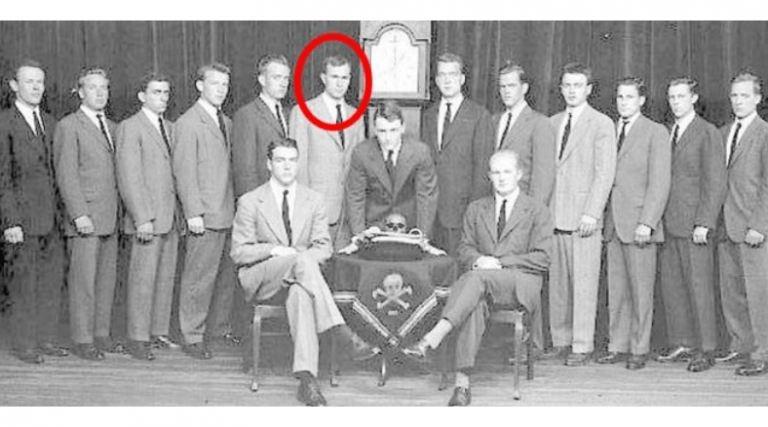
Skull and Bones, also known as The Order, Order 322 or The Brotherhood of Death is an undergraduate senior secret student society at Yale University in New Haven, Connecticut. The oldest senior class society at the university, Skull and Bones has become a cultural institution known for its powerful alumni and various conspiracy theories. It is one of the "Big Three" societies at Yale, the other two being Scroll and Key and Wolf's Head.
It struck me that what I had learned about the German students might be only a tiny Nazi connection that had only accidentally come to light, but perhaps a trace of something much deeper, broader, and more insidious than anyone would admit. Was my imagination running away with me? Perhaps. But it is impossible to see one cockroach in your house and believe that only one cockroach is living in your home. A skin-crawling feeling overcame me—the feeling that perhaps a great many of the world's wealthiest citizens were living off the interest from the stolen legacy of my murdered progenitors. At best, it was clear that the specter of Fascism, which I had wanted to leave behind, was intent on shadowing me no matter where I went. Not everything one feels obeys the laws of logic and rationality—and yet our feelings are real. They define everything about who we are.
William Randolph Hearst, Joseph Kennedy, John Rockefeller, Henry Ford, Allen Dulles, Prescott Bush, and Andrew Mellon (head of Alcoa, a banker, and Secretary of Treasury) were some of the few American magnates whose Nazi connections I discovered in my research. Similarly, I was stunned to learn that American corporate heavyweights like DuPont, General Motors, Standard Oil, ITT, National City Bank, and General Electric had all contributed to the Nazi regime.
Particular examples of American-Nazi ties were still more shocking to me. For example, "in October 1938, Göring, acting on behalf of the Fuehrer, presented Charles Lindbergh with the Service Cross of the German Eagle for his contributions to aviation." General Motors and Ford built almost all of the armored 3-ton half-trucks and most medium to heavy-duty trucks used by the Nazis in World War II. "Graeme K. Howard, Vice President of General Motors, wrote and published America and a New World Order and argued that America should cooperate with the Nazis." The DuPont's financed the Black Legion, an American Nazi group that used violence against unions and was connected to the Ku Klux Klan. And William Randolph Hearst was a steadfast supporter of the Nazi party.

Upon his return to the United States, Charles Lindbergh became one of the strongest voices of an American Isolationist policy as WWII broke out. His public speeches against providing aid to European nations, even implying that a Nazi domination of Europe would lead to a stronger conflict against communist Russia.
My most disheartening discovery involved Thomas J. Watson and the Hollerith number tattoos. In 1933, Watson, the head executive of IBM, leased to the Nazis data-sorting computers that used IBM's Hollerith punch card technology. These computers enabled the Nazis to identify, find and collect the victims of the Holocaust. The numbers tattooed on the Jewish prisoners were of the Hollerith numbering system! Adolph Hitler awarded Watson a medal for his contribution.
Watson's early career demonstrates criminal behavior and lack of ethics that was pervasive in the United States between the wars. When the Nazis seized power, like many other American entrepreneurs, Watson saw an opportunity to expand in Germany. In the depths of the Great Depression, Watson increased IBM's investment in Germany by nearly a million dollars. Even more economically gratifying for him was the secret pact he concluded in October 1933, founding Dehomag, a German IBM subsidiary, and giving it commercial powers beyond the borders of Germany. Previously, all IBM subsidiaries had been confined to a single country. With Dehomag now established as the de facto "IBM Europe," the Nazis could conduct statistical services throughout Europe. In effect, Watson had established a cartel much like I.G. Farben's.

Thomas John Watson Sr. (February 17, 1874 – June 19, 1956) was an American businessman. He served as the chairman and CEO of International Business Machines (IBM).[1][2] He oversaw the company's growth into an international force from 1914 to 1956. Watson developed IBM's management style and corporate culture from John Henry Patterson's training at NCR.[3] He turned the company into a highly effective selling organization, based largely on punched card tabulating machines. A leading self-made industrialist,[4] he was one of the richest men of his time and was called the world's greatest salesman when he died in 1956.
In an attempt to justify Watson's—and IBM's—dealings with the Nazis, many suggest that Watson was not a Fascist but simply a ruthless businessman. Evidence, however, indicates that if Watson was not a Fascist, he was, at the very least, a great admirer of Fascism. At a 1937 sales convention, Watson said, "I want to pay tribute (to the) great leader, Benito Mussolini. I have followed the details of his work very carefully since he assumed leadership. Evidence of his leadership can be seen on all sides. Mussolini is a pioneer. Italy is going to benefit greatly." That was not the only evidence of Watson's support and admiration for Fascism. He also had an autographed picture of Mussolini hanging in his living room for years. Watson was quoted as (3
saying, ) "We )should pay tribute to Mussolini for establishing this spirit of loyal support."
Henry Ford's ties to the Nazi party are equally well-documented. Hitler cited Ford as his inspiration in a 1933 interview he gave to a Detroit News reporter two years before becoming Chancellor of Germany. The Nazi government also awarded Ford the Grand Cross of the German Eagle, the highest medal for foreigners. Ford received this award in July 1938, four months after the Germans annexed Austria. Ford was unsupportive of the Franklin D. Roosevelt administration, and he did not think the United States should be involved in the war. Henry Ford had almost no communication with the War Production Board during the war. Instead, Edsel Ford and other associates worked with the Board between 1939 and 1943. Even after the attack on Pearl Harbor, Henry Ford did not want his factories used for war work. When Edsel Ford died in 1943, Henry Ford took over the company's control again, but he refused to return the Grand Cross medal he had received from the Nazis.

Henry Ford is an American icon who was also a Nazi sympathizer with rabid anti-Semitic views. Under his leadership, Ford Motor Corporation became the engine of the American economy and one of the nation’s most iconic brands. Likewise, history books celebrate its founder Henry Ford as one of the nation’s greatest industrialists.
In a still-more-shocking post-war gesture, Ford and IBM demanded that the U.S. government reimburse their companies for the loaned assets destroyed in the war. And we, the American people, paid them!
American academia also made an intellectual contribution to the Nazi project. The Nazi party was incredibly impressed with American scientists' study of eugenics, which claimed that social ills resulted from genetic inferiority and not social conditions. In 1907, Indiana first legalized forced sterilization of the inferior—the poor, the imprisoned, and the mentally ill. The Rockefeller Foundation funded and endorsed eugenics programs. We cannot understate the effect that American eugenics studies had on the ultimate success of the Nazi program.
My studies filled me with questions. My faith was fractured, and America seemed filled with flaws. The Nazis were pro-Christian and anti-Communist—certainly anti-Marxist. They imprisoned atheists and labor leaders—a fact that sounded right-wing to me. Because the Nazis embraced the Catholic Church—a Church that had embraced Hitler—I wondered if I should consider Christianity itself Fascist. I asked, too, why the Nazis viewed "liberals" as their enemies. However, America and its flaws were still preferable to be swallowed up by Stalin's gulag.
I had to make changes for myself in Holland. I had committed to Holland's army, I had a family who loved me, and I had a girlfriend as well. I wanted to live up to the very forthrightness and integrity Papa had taught me and which I so admired in him, so I had no choice but to say goodbye to my homeland. Papa so dearly wanted me to help carry on his business, but an internal voice said, "Go to America, you young man." The hardest part was knowing that I would disappoint my mother.
My mother had been my inspiration. My family in Holland was very patriotic, intensely devoted to Holland. My mother worked in the Dutch Resistance during World War II, but besides Holland, her other love was the Jewish people. She dreamed that I go to Israel, where she saw the true beginnings of our collective Jewish future.
However, I chose to disregard my mother's wishes and go directly to America. My mother would see me leave home again as a young man. Like my father before me, I was nervous about what I would find in America. We all knew that during the Holocaust, American Jews wanted to help their European brethren. Few, however, knew the extent of the suffering European Jews had endured. American Jews were also unaware of the U.S. State Department's involvement in the obstruction and delay of supply shipments to send aid to Jewish children in Europe.
In my initial journey to America, I received a great deal of assistance from the Hebrew Immigrant Aid Society (HIAS), which helped the foreign-born and their families who sought permanent legal status and citizenship in the United States. HIAS offered counseling and processing services for refugees and allowed them to join the U.S. Army. I was at an age where I might serve in the IIDF of Israel, but I always believed that the Americans and Canadians had given their lives to save me. I felt that I had to return the favor and serve in either the Canadian or the American armies.

HIAS (founded as the Hebrew Immigrant Aid Society[4]) is a Jewish American nonprofit organization that provides humanitarian aid and assistance to refugees. It was originally established in 1881 to aid Jewish refugees.
Before I left for the United States, Papa had decided to get another dog—a Doberman Pinscher. Doberman Pinschers, or simply Dobermans, are among the most common pet breeds, and the species is well known as an intelligent, alert, and loyal companion dog. Although often used as guard dogs or police dogs, the Doberman is usually a one-master dog that only takes commands from its master.
In Holland, it was common to let dogs roam freely. Most of the time, our Doberman stayed around the house. However, the mailman had reported that a large black dog had attacked a nun on her bicycle. This attack was the talk of the town, but other than the Catholic nun, no one had seen the attacking dog. One morning, when I took a walk to my chicken cage, I found a pile of black cloth. "Oh no," I thought, "our Doberman could have done that." Another time, when we lived next to an animal farm, the Doberman wanted to hunt a three-month-old lamb. Papa commanded him to come home, but the dog paid no attention. Papa ran after it but sprained his ankle, which took over a year to heal.
On a ski trip, Papa found a family willing to take care of the Doberman for three weeks. We had just arrived at our hotel in Switzerland when the family told us that the Doberman did not like the movement of the lit candles on the Christmas tree. He had jumped over the tree and started a fire. The family threw the Doberman out of their house. Then, the dog began to remove the tulip bulbs from the flower beds in the park. Papa suggested that the police bring him to a kennel, but he acted like a wild tiger even in the kennel. We decided that we could no longer take care of the Doberman. The vet who had examined him thought that worms had gotten into his head. We had no other choice but to have him destroyed.
Friction was setting in among the members of the Cardozo clan. There had been friction between Papa and Ido since 1953. Now, Ido changed his name to Ido Fortuin. Papa had opened a store for him in Alkmaar and built him an apartment behind the store. Ido had moved into the apartment with his new wife, Dora, and then taken a honeymoon for two weeks. Friction set in when Ido's wife locked all of the cabinets throughout their living room. Mama did not like this but said nothing.
However, shortly after their honeymoon, Mama became very upset with Ido's wife. She had blamed Mama for not getting Ido part of his natural father's assets. Mama said, "We got you an apartment, and later on, the store will be yours," but Dora did not like those terms. Dora asked her father to help them get a new house away from the store. Their first baby was born, and more friction came to light; a cash shortage and merchandise started to make Ido's firm the first of the family businesses with a loss. Nobody could explain this loss.
Now, two of Papa's sons were active, and my mother wanted to understand the reason for the loss at Ido's store. She decided to hire a famous psychic who was highly regarded and well known for his work in international cases. The psychic's son went to my school. At the University of Utrecht in Holland, his field is called extrasensory perception (ESP). It involves receiving information not gained through the recognized physical senses but sensed with the mind. When my mother asked the psychic for his help, he said that he was working on some cases for the University of Utrecht and could recommend another person who was as good as he was. Mama went to pick the new psychic up at the University of Utrecht, along with a detective of the Dutch police department. The detective was not allowed to question people until there was a reason. First, the psychic asked for handwriting samples and photographs of each employee, so Mama got that information.
My brother and I were not informed, but Mama thought that we might as well be investigated for the sake of the business. My brother and I never knew anything about what she was doing, but the psychic started his work with the help of the local police department. I later learned that the psychic's report about me stated that I was honest but sloppy in handling paperwork.
The psychic found three persons he thought should be questioned, and he selected the lowest-paid worker of the three: a gardener/delivery man. The psychic called this person of interest into his presence and started a conversation with him. After a few minutes of talking, the psychic called in the detective but did not tell the person of interest that he was a detective. The psychic had told the detective not to say anything until he shifted his notebook from one hand to the other. That gesture meant that the detective could start reading the man his rights.
The psychic began to question the man of interest, and the man of interest began to sing. He had only stolen two pairs of pants. Now the police could ask him for up to twenty-four hours. The man broke down and told the police that he was stealing for the accountant; he would deliver the stolen money to him after paying for two. The copy of the sales slip had no carbon and was always made out by the accountant. So now, the accountant was called in. He had no way to deny he had stolen several hundred thousand guilders over the years. Papa did not want charges against either man, but he knew that they had spent everything on luxury items and entertainment, so Mama and Papa took the police reports to the tax department to get a write-off. Then, Papa and Mama hired professional managers for each store, with the proper textile licenses and university graduate papers.
Papa went back to selling his trade on the road. His new staff helped set up a complete line of ladies' and mens' leisure clothing. She replaced Papa's woolen suits with rayon and nylon clothing; fashion had taken a 180-degree turn. Things changed very fast among this new generation, making their own money and buying their clothes. Papa and I no longer interfered with Ido and did not friction him. I was ready to leave the Cardozo business soon, and Ido went away to work with his father-in-law.
Another dilemma hit me when my friend Morrice Morris from Inverness Scotland stayed with us for two weeks in our house in Benningbroek. We would spend time at the Amsterdam cafes and my rowing club, Poseidon. I introduced him to my girlfriend, Marty Hartog, and found out that he had taken Marty out on a date before he returned to Inverness. This date became serious a short time later, and I realized that Marty's love for me had ended, and she did not want to see me anymore. This news broke my heart. My sisters, who had met Marty, were also heartbroken because they liked her. My sisters cried when I gave them the bad news.
So I was happy to leave Holland. I was also excited to go because most young people my age had become somewhat wild, with long hair and broken-down jeans. A whole new generation was born, and it was not my taste.
The solution to my dilemma came in an offer from the United States Army. My language studies qualified me for a terrific French and English interpreter job. I already had good feelings toward the U.S. Army; like many people of my time, I felt they had helped save my life. So I jumped at their offer.
I was drafted into the Dutch army on September 6, 1955. My army number was 37 01 11 062. When I received authorization to serve in the U.S. Army, my mother and I made arrangements to buy an airline ticket from Amsterdam to New York. She kept saying, "Max, I have seen you so little, and now you are going to fly away like a bird. We are going to miss you."

New York in the 1960s saw countless strikes and protests. And, sometimes, protest boiled over into violence. During the Harlem riot of 1964, for example, African-Americans rebelled against police brutality after an officer killed a 15-year-old boy. The ensuing riot roped in some 4,000 New Yorkers, leaving more than 100 injured and 450 arrested.
The day of my departure arrived, and whatever family we had left after the war came to the airport and said goodbye. Like a big boy, I got on Board the Lockheed Super Constellation Triton. Our first stop was for refueling at Shannon. At the Shannon airport, hundreds of adults sent their children off to other countries to protect them from the struggle between the Protestants and the Catholics in Ireland. The Protestants believed they were the majority and that the Catholic minority did not exist. The two sides were battling it out, and the children were suffering. I could not understand. We had just ended a war with Germany, and now, I could see hatred in yet another country. Watching these young ones holding onto their parents was a sad sight.
The plane took off for the transatlantic leg of our journey. We had about fifty passengers and three crew members, but I had never flown more than 200 miles before. I was not wholly sure about aircraft engines and how they worked. I had a window seat on the aircraft, and I saw flames shooting out the motor. It made me nervous, so I asked one of the crew members and was told that this was normal and that I could see the flames more clearly at nighttime. So I closed the curtain and went to sleep.
Hours later, I arrived at the Idyllwild airport in New York, which was very noisy. Bull horns and loudspeakers blared from all directions, announcing taxis, buses, and pages. It was so loud that I felt like an animal ready for the slaughterhouse.
Before leaving Holland, I received authorization to leave the Dutch army as long as I received army training in the United States. However, before I made this move, I wanted to spend some time with the Americans, the people I would later live with, and for whom I would soon work. First, I had to finish my schooling.
I took a bus to a Manhattan hotel. I had arrived in my new home. From there, I first went to the Horn & Hardart Automat, a 42nd Street combination of fast-food, vending machines, and a cafeteria-style restaurant. There, I could get a meal for less than a handful of nickels and the twist of a wrist. I bought a good square meal: macaroni and cheese, Boston baked beans, chicken pot pie, and rice pudding.

Inspired by Max Sielaff [de]'s Automat Restaurants in Berlin, they were among the first 47 restaurants, and the first non-Europeans, to receive patented vending machines from Max Sielaff's Automat GmbH factory in Berlin, the creators of the first chocolate bar vending machine for Ludwig Stollwerck [de].
My first job was as a stock boy in the Manhattan Garment center. I hoped to meet some people from home, but it was tough. My boss told me that I could not use the telephone, and I had no phone in my hotel room. The only payphone I could use was in the lobby of my hotel, and although it cost only five cents, I had no idea how to use an American payphone. Before, I had never used a payphone with alpha-numeric letters and could not call anyone.
Between my hotel on 34th Street and work on 45th Street, I explored what New York had to offer. Forty-second Street was a haven for electronic gadgets of all sorts. People could place their hands on a particular spot in a store window, turning on a T.V. and allowing them to watch a show. I had never seen this kind of instant entertainment. Forty-second Street was also unique in other ways. For instance, people could look through a hole in a designated spot on a window and watch a girl lift her skirt for five cents. These were called "peep shops." Or, for the same five cents, people could watch three midget movie features.
Besides being a haven for electronic gadgets, 42nd Street was always awash with prostitutes, pimps, drug dealers, chicken hawks, and other hustlers. Early morning commuters poured like a swell out of the Port Authority Bus Terminal on Eighth Avenue and crossed 41st and 43rd Streets on their way east. The bow parted around 42nd Street as if blocked by a huge boulder. Different workers passed out fliers for many different things every day, including dental implants and teeth whitening! Most people wouldn't take a flier, and others just threw them on the ground. They didn't want to be bothered by this informal kind of advertising. The streets were always hectic and noisy.
I heard "Get away from me!" constantly. New Yorkers had become so used to being accosted by beggars that they walked briskly past one another as if in deep thought, avoiding eye contact. That famous saying about being lonely in a crowd has all the more meaning in New York City. The few times I asked people for directions, they reacted by stepping vehemently aside without answering. These people used them for their freedom. However, I did not want to respond in the same nasty way, and I restrained myself from being rude. Those early days in New York affected me profoundly. Today, when I pass people on the street giving out fliers, I always take them because I know it's like when people just won't take an interest.

42nd Street is a major crosstown street in the New York City borough of Manhattan, running primarily in Midtown Manhattan and Hell's Kitchen. The street is the site of some of New York's best known buildings, including (east to west) the headquarters of the United Nations, Chrysler Building, Grand Central Terminal, New York Public Library Main Branch, Times Square, and the Port Authority Bus Terminal.
Millions of people were in New York City, but many were not Americans. I often met foreign military people who wanted to talk about leaving their militaries and transferring to the United States. The foreigners were, in fact, more excellent than the Americans.
In contrast to the daytime bustle of the city streets, dawn at Broadway and 42nd in Times Square, known as the "Crossroads of the World," was ghostly. The neon signs, now dimmed from dawn's light, still blinked, but no one saw them. I used to watch as dawn gave way to activity and the day began:
Delivery trucks drove by.
Vendors rolled out their carts.
Birds started to chirp, store owners, swept or hosed down sidewalks.
As life geared up on the mall that Times Square had become, vendors started to move south down 7th Avenue to catch customers leaving the clubs in the garment district—drunk people liked to eat! From X-rated entertainment to pinball parlors to phony-identification shops, this area was alive with activity and with con artists. Amid this awakening, a newcomer might arrive—a soldier, for example, just off the bus and heading straight for Times Square. Times Square was one big temptation for that soldier and other newcomers.
Here amidst ads for luxury items and signs announcing "Live! Nude! Girls!" the Lubavitch seemed entirely out of its element. The Lubavitch was, and is still, dedicated to the spiritual and physical welfare of Jews worldwide, no matter their denomination, station in life, or financial situation. It is a sort of Salvation Army concept. So although the Lubavitch appeared out of place in this vibrant and colorful area of New York, perhaps it was well-situated to assist those in need.
Changes in the United States
I had now been back seven years and had found that even America had changed. It is as though after the baby boomers came of age as individuals and became scholars with widely varying opinions, both technically and culturally, that they had rejected or redefined the traditional values of both older and younger generations. The baby boomers were among the first to grow up genuinely expecting that the world would improve with time; they tended to think of themselves as a particular generation, which was very different from those that had come before.
The baby boomers had started a generation built on easy credit, while the Clinton days reminded me of the Roaring Twenties. The 1990s was the decade when Internet and e-Commerce technologies emerged. During the 1990s and early 2000s, Wall Street's successes and the Dotcom boom symbolized the period, and the baby boomers became revolutionaries like those we had seen during the Roaring Twenties. The phrase "Roaring Twenties" emphasized the period's social, artistic, and cultural dynamism.

Wall Street brokers gesturing to signal trades on the Curb Market in the mid-1920s. The Curb Market was for stocks not listed on the New York Stock Exchange.
The Clinton years were followed up by a weak President, George Bush, whose two terms began in 2001 and ended in 2009. He was seriously damaged during his time in office because of the al-Qaeda bombings of the Twin Towers and the Pentagon, and the plane crashed in rural Pennsylvania. These events were too much for one man to handle. Things go out of hand. I trusted Bush's White House team to take some pressure away after these terrible events. They made tons of companies to invest in, and many investors thought they could make a massive profit by putting lots of money into them. At this time, there was also a housing bubble—an enhanced demand for real estate, especially housing, that is often created through artificial means, including the lowering of interest rates. The housing bubble started an economic boom, but it ended in times of hardship.
Because Bush did not have the military experience that his father did, these were hard times to make decisions. The U.S. brilliantly executed the war in Iraq, but it dragged on for too long. The military did not have the proper intel on hand to make the right decisions. On top of all of these problems, Katrina happened, which was poorly executed.
We now had a new generation with President Obama. He would have liked to bring the Americans a step down as world leaders, and he planned to follow this step-down with the new world order. However, coming from a nation that needed Americans in a leadership role, I realized that a world without America as a world power would not work. But the American voters wanted to vote for a change in leadership. They got it, so life in America was about to change. I hope that I'm wrong and that we are not all in for a time of turmoil, but I am not sure how this will all come out in the end.
Thinking back to my days as a child and youth, I wonder what it was that made the world tumble into destruction. The German Jews, brilliant, cultured, and cosmopolitan as they were, were too complacent. They had been in Germany so long and were so well-established, they simply couldn't believe there was going to be a crisis that would endanger them. They were too comfortable. They thought that the Nazis' anti-Semitism was an episodic event, the hand that Hitler's bark was worse than his bite. This complacency caused them to react sluggishly to the rise of Hitler for completely understandable but tragically erroneous reasons. Events moved much faster than they could have imagined. That is one of the most tragic examples of the devastating effects of the "normalcy bias" that the world has ever seen.
Just think about what was going on at the time. Jews were arrested, beaten, taxed, robbed, and jailed for no reason other than that they practiced a particular religion. As a result, they were shipped off to concentration camps. The Nazis seized their homes and businesses.
Yet most Jews still did not leave Nazi Germany because they couldn't believe that things would get as bad as they did. That's the normalcy bias., and with devastating results.
We saw the same thing happen during Hurricane Katrina. Even as it became clear that the levee system was not going to work, tens of thousands of people stayed in their homes, directly in the line of the oncoming waves of water. People had never seen things get this wrong before, so they didn't believe it could happen. As a result, nearly 2,000 residents died.
And again, it's the "normalcy bias." We simply refuse to see the evidence right in front of our faces because it's unlike anything we have experienced before. The normalcy bias kicks in as we continue to go about our lives as if nothing is unusual or out of the ordinary.
Well, we're seeing the same thing happen in the United States right now, where we have been the world's most powerful country for the last 100 years. FOR MORE THAN FIFTY YEARS, the U.S. dollar has reigned supreme as the world's reserve currency. Most of us in America simply cannot fathom these things changing. But I promise you this: Things are changing faster than most people realize.
For a moment, just look at a tiny fraction of the evidence around us.
Did you know that there are now nearly 42 million Americans are on food stamps? That's almost 13% of the entire population. Those numbers are up 17.5% from the year before. The number of Americans on food stamps has gone up every month for 19 months and counting. Can a country be in good shape when 13% of the population can't even afford to buy food?
Or how about our country's unique ability to simply print more money? The U.S. government has one essential weapon to use in this crisis: It is the only debtor in the world who can legally print U.S. dollars. And the U.S. dollar is what's known as "the world's reserve currency." The dollar forms the basis of the world's financial system. It's what banks around the world hold in reserve against their loans. That's a secret that most politicians don't understand: As things stand now, the U.S. government can't go broke in any ordinary sense of the word because it can simply print dollars to pay for its bad debts. (It's been doing so since March of 2009.) Printing money might sound pretty good at first. Since we can always print more money, what is worrying about anyway? Well, let me show you.

People say the Fed is printing money when it adds credit to accounts of federal member banks or lowers the fed funds rate. The Fed does both of these actions to increase the money supply. The Bureau of Engraving and Printing, under the U.S. Department of Treasury, does the actual printing of cash for circulation.
You see, as things stand today, America is the only country in the world that doesn't have to pay for its imports in a foreign currency.
Let's say you're a German. You want to buy oil from Saudi Arabia. You can't just pay for your oil in German marks (or Euros) because the oil is priced in dollars. So you have to buy dollars first, then buy your oil. And that means the value of the German currency is of great importance to the German Government. To maintain the value of its currency, Germans must produce at least as much as they consume from around the world; otherwise, the value of the German currency will begin to fall, causing prices to rise and its standard of living to decline.
But in America...?
We can consume as much as we want without worrying about acquiring the money to pay for it because our dollars are accepted worldwide. In short, for decades now, we haven't had to produce anything or export anything to get all the dollars we needed to buy all the oil (and other goods) our country required. All we had to do was borrow the money. And boy, did we.
Even as late as the 1970s, America was the world's largest creditor. But by the mid-1980s, we'd become a debtor to the world. And since the late 1990s, we've been the world's largest debtor. Today, our Government owes more money to more people than anyone else in the world. I believe that at some point, foreign countries will either completely stop accepting dollars in repayment or will significantly discount the value of these new dollars. I'm sure you think that sounds crazy, but as I'll show you, it is already happening.
For example, one of the largest banks in Mexico no longer allows you to deposit U.S. dollars into their banks. Although they've done this on the heels of money-laundering allegations, we suspect they also don't want to be stuck with tons of U.S. dollars while the currency continues to decline. This move would have been unfathomable ten years ago; that a big bank in Mexico would no longer accept U.S. dollars for deposits. But today, this is the harsh reality.
And Mexico is not the only place this is occurring.
Reuters reports that the same thing happened in 2008 in one of Europe's most popular tourist spots. In Amsterdam, currency exchange outlets have been reportedly turning away customers who want to exchange their U.S. dollars for Euros. One traveling American said as much to the Reuters news agency. "Our dollar is worth maybe zero over here," said Mary Kelly, an American tourist from Indianapolis, Indiana, in front of the Anne Frank house. "It's hard to find a place to exchange. We have to go downtown, to the central station or post office."

Petrodollar recycling is the international spending or investment of a country's revenues from petroleum exports ("petrodollars"). It generally refers to the phenomenon of major petroleum-exporting states, mainly the OPEC members plus Russia and Norway, earning more money from the export of crude oil than they could efficiently invest in their own economies.
In India, the country's tourism minister said in 2008 that U.S. dollars would no longer be accepted at the country's heritage tourist sites, like the Taj Mahal. And the U.S. dollar is no longer good anywhere in Cuba.
The New York Times reports, "Now, many shops in China no longer accept dollar-based credit cards issued by foreign banks... and foreigners cannot convert American dollars into renminbi beyond a given quota."
Iran, of course, has already moved all of its reserves out of U.S. dollars, and Kuwait de-pegged its currency from the dollar a few years ago.
Bloomberg News recently reported that China and Russia plan to start trading in each other's currencies to diminish the dollar's role in global trade. "Given the risk to the dollar and U.S. assets from their fiscal position, they want to reduce their dependence on the dollar. It's not a matter of "if" the U.S. dollar will lose its status as the world's reserve currency. It's simply a matter of "when."
Why does the Middle East have so many problems, and why are they all manifesting themselves simultaneously? Why now all of a sudden?
All our leaders are corrupt in more ways than you can imagine. However, Tunisia was the first country to take action against this corruption, and its people succeeded in removing their dictator. That made its neighbors, specifically Egypt, Libya, Lebanon, Syria, Yemen, Oman, Bahrain, Saudi Arabia, and Qatar, the first to mark this question as enjoyable!
If you're talking about the many countries undergoing civil unrest, consider that many of these countries have cultural values dating back to the 14th century, even though they are as modern as they are. Think of a society with so little industry that only a very few people can work. One should also consider that being in the Western world and holding its values is not valued by everyone.
For a very long time, I think the Middle East was regarded as a mere stepping stone for foreign affairs. This area famously enjoys many riches, including landscapes, oil, and other minerals.
As you read in the Bible, Ezekiel 38 and 39, it isn't just the creation of the nation of Israel that makes this prophecy seem likely to be fulfilled shortly. The countries that God tells us will form a coalition against Israel seem more likely now than perhaps ever before to create just such an alliance. To understand the prophecies of Ezekiel in regards to this future invasion, it's essential to understand who the players will be.
Jacques Gautier, a Canadian international lawyer, has done twenty years of research on the legal status of Jerusalem. He has written a dissertation of some 1,300 pages with 3,000 footnotes. The entire document is in a binder fourteen inches long, twelve inches wide, and four inches thick. Every page is supported by legal research. I asked Dr. Jacques Gautier how people can make decisions without having sufficient legal information and, specifically, why the United Nations and international courts are in the hands of fools and politicos. I wondered what feeds the writing of these fools and politicos.
Dr. Jacques Gautier is not Jewish, but he should be honored for his efforts and should be recognized as one of the "Righteous Among the Nations," just like my saviors after my time of hiding during World War II. I find it shameful that worldwide, Jewish law professors sit back and let the Israeli situation fester and let the world go by. I wonder what they are waiting for.
Dr. Jacques Gautier explains that he has been practicing law for thirty years, twenty-five of which he has worked as an international human rights lawyer. He has made it his life's work to set this right.

Jacques Gautier (born 18 September 1946 in Aix-en-Provence) is a French politician and a member of the Senate of France.He represents the Hauts-de-Seine department and is a member of the Union for a Popular Movement Party..
Part of setting things right has been to correct the misinformation in a report spearheaded by South African judge Richard Goldstone. This report charges both Israel and Hamas with committing war crimes during the three-week operation launched by Israeli Defense Forces after Gaza sent over thousands of rockets from Gaza to the southern communities of Israel.
Israel has rejected the Goldstone report.
Palestinian sources say they believed that the Consul General had passed on an unequivocal request from Secretary of State Hillary Clinton to ensure that the document remained on the table at the Human Rights Council. Palestinian officials say that there was "heavy and ongoing pressure" from the U.S., which warned that adopting the findings in the commission's report would impede the peace process between Israel and the Palestinians.
The Government commented on the Goldstone report by scholars like Dr. Jacques that indicated that the information had been misrepresented and was not an honest report. Why did Dr. Jacques Gauther spend twenty-five years researching? He answered that so many people before him had given so many contradictory and confusing answers—the Muslims said one thing and the Christians another. Dr. Jacques Gautier concluded that someone must be wrong. He wanted to find out who originally owned Jerusalem, and after twenty-five years of work, he concluded that the Jews were the rightful owners. His explanation follows.
The Balfour Declaration of 1917 started the process, but it didn't create international legal rights. Dr. Jacques Gautier showed us a photograph from the San Remo Villa, where the Government decided on April 25, 1920. This document incorporated the Balfour Declaration of 1917 and Article 22 of the Covenant of the League of Nations. That was the decision upon which the Mandate for Palestine was constructed. While the decision made at San Remo created the Palestine Mandate de-facto, the mandate document signed by Great Britain as the Mandatory and the League of Nations made it de-jure. It thus became a binding treaty in international law. During the "Council of Four" meetings in 1919, British Prime Minister Lloyd George stated that the McMahon-Hussein Correspondence was a treaty obligation. He also explained that the agreement with Hussein had been the basis for the Sykes-Picot Agreement. He told the French Foreign Minister that the proposed League of Nations Mandate System could not be used as an excuse to break the terms of the Hussein Agreement. Under the Sykes-Picot Agreement, the British and French had agreed to an independent Arab state with the Sharif of Mecca. The French had also decided that their military would not occupy Damascus, Homs, Homa, and Allepo. As early as July 1919, the parliament of Greater Syria had refused to acknowledge any right claimed by the French Government to any part of Syrian territory.

Balfour Declaration, (November 2, 1917), statement of British support for “the establishment in Palestine of a national home for the Jewish people.” It was made in a letter from Arthur James Balfour, the British foreign secretary, to Lionel Walter Rothschild, 2nd Baron Rothschild (of Tring), a leader of the Anglo-Jewish community.
On September 30, 1918, supporters of the Arab Revolt in Damascus declared a government loyal to the Sharif of Mecca. He had been declared "King of the Arabs" by religious leaders and other notables in Mecca. On January 6, 1920, Prince Faisal initialed an agreement with French Prime Minister Clemenceau, which acknowledged "the right of the Syrians to unite to govern themselves as an independent nation." A Pan-Syrian Congress meeting in Damascus had declared Syria an independent state on March 8, 1920. The new state included Syria, Palestine, Lebanon, and northern Mesopotamia, set aside under the Sykes-Picot Agreement for an independent Arab state or confederation of states. King Faisal was declared the head of state. At the same time, Prince Zeid, Faisal's brother, was announced regent of Mesopotamia.
The San Remo conference was hastily convened. Great Britain and France both agreed to recognize the provisional independence of Syria and Mesopotamia while "reluctantly" claiming mandates for their administration. Palestine was composed of the Ottoman administrative districts of southern Syria. Under customary international law, early recognition of its independence would be a gross insult to the Government of the newly declared parent state. It could have been construed as a belligerent act of intervention without any League of Nations sanction.
The High Contracting Parties agreed to entrust, by application of the provisions of Article 22, the administration of Palestine, within such boundaries as may be determined by the Principal Allied Powers, to a Mandatory, to be selected by the said Powers. The Mandatory will be responsible for putting into effect the declaration originally made on November 8, 1917, by the British Government, and adopted by the other Allied Powers, in favor of the establishment in Palestine of a national home for the Jewish people, it being clearly understood that nothing shall be done which may prejudice the civil and religious rights of existing non-Jewish communities in Palestine, or the rights and political status enjoyed by Jews in any other country.
The Arabs weren't even mentioned, but civil and religious rights were only accorded to other inhabitants. That thereby excluded political rights.
Article 22 of the Covenant of the League of Nations provided for the creation of mandates:
To those colonies and territories which as a consequence of the late war have ceased to be under the sovereignty of the States which formerly governed them and which are inhabited by peoples not yet able to stand by themselves under the strenuous conditions of the modern world, there should be applied the principle that the well-being and development of such peoples form a sacred trust of civilization and that securities for the performance of this trust should be embodied in this Covenant.
The legal significance here is that "the well-being and development of such peoples form a sacred trust of civilization." The Mandatory Power was the trustee of that trust.
The Palestine Mandate of the League of Nations included the following significant recital:
That had never happened before in history. Palestine was to be held for the Jewish people wherever they lived. No such recognition had ever been accorded to anyone else, anywhere, ever:
The Mandatory shall be responsible for placing the country under such political, administrative, and economic conditions as will secure the establishment of the Jewish national home, as laid down in the preamble, and the development of self-governing institutions, and also for safeguarding the civil and religious rights of all the inhabitants of Palestine, irrespective of race and religion.
Thus, the operative clause expressly referred to the preamble and reiterated that there were no political rights for other inhabitants:
The Mandatory shall be responsible for seeing that no Palestine territory shall be ceded or leased to or in any way placed under the control of the Government of any foreign Power.
The Administration of Palestine, while ensuring that the rights and position of other sections of the population are not prejudiced, shall facilitate Jewish immigration under suitable conditions. In co-operation with the Jewish Agency, they shall encourage close settlement by Jews on the land, including State lands and waste lands not required for public purposes.
The United Nations took over from the failed League of Nations in 1945, and its Charter included
80, that "nothing in this Charter shall be construed in or of itself to alter in any manner the rights whatsoever of any states or any peoples or the terms of existing international instruments to which Members of the United Nations may respectively be parties."
Thus, the Palestine Mandate continued without change.
In 1947, the General Assembly of the U.N. passed Resolution 181, which became known as the Partition Plan, under which both Jews and Arabs could announce their states.
First, we must note that the Charter of the U.N. specifically gave no power to the General Assembly because that would infringe on the sovereign power of individual members. So the General Assembly could recommend only. Secondly, this recommendation violated the terms of the Mandate.
This resolution also provided for a Special Regime for Jerusalem, which had the following defined boundaries,
A. SPECIAL REGIME The City of Jerusalem shall be established as corpus separatism under a special international regime and administered by the United Nations. The Trusteeship Council shall be designated to discharge the responsibilities of the Administering Authority on behalf of the United Nations.
B. BOUNDARIES OF THE CITY The City of Jerusalem shall include the present municipality of Jerusalem plus the surrounding villages and towns, the most eastern of which shall be Abu Dis; the most southern, Bethlehem; the most western, 'Ein Karim (including also the built-up area of Motsa); and the most northern Shu'fat, as indicated on the attached sketch-map (annex B).
But this regime was to be limited in time. Jerusalem was not an "international city" for all time, as we have been led to believe.
In the Statute elaborated by the Trusteeship Council, the
The principles above shall come into force not later than October 1, 1948. It shall remain in detail in the first instance for ten years unless the Trusteeship Council finds it necessary to undertake a re-examination of these provisions at an earlier date. After the expiration of this period, the whole scheme shall be subject to examination by the Trusteeship Council in the light of experience acquired with its functioning. The residents of the City shall then be free to express using a referendum their wishes as to possible modifications of the regime of the City.
This provision for a referendum was critical to the acceptance of Resolution 181 by Ben Gurion. He knew that the Jews were in the majority within these boundaries and would be when the referendum was held in ten years. Thus, he was confident that Jerusalem would return to Jewish hands.
Keep in mind that the disposition of this area was to be determined, not by Israel, but by the residents of Jerusalem so defined. Currently, the Jews have a 2:1 majority there.
Needless to say, after the Armistice Agreement of 1949, the Jordanians, who were in control of Jerusalem, violated every provision of this resolution calling for, among other things, respect for holy places. The referendum never took place.
After the '67 war, Israel regained the land to the Jordan, including Jerusalem; resolution 242 of the Security Council was passed authorizing Israel to remain in possession of all the ground until they had "secure and recognized boundaries." It did not require Israel to withdraw from all territories, and it was silent on Jerusalem.
The resolution also "Affirms further the necessity for achieving a just settlement of the refugee problem." There was no reference to Resolution 181, nor was there a distinction between Jewish and Arab refugees.
Based on this, I suggest that not only should Israel demand that the referendum be held now, but Jerusalem should be the first order of business. Israel should demand that the referendum take place before the balance of the land is negotiated. There is nothing to discuss if the Arabs won't agree to the referendum.
In closing, I would like to stress one more thing.
By this preamble,
Whereas recognition has thereby been given to the historical connection of the Jewish people with Palestine and to the grounds for reconstituting their national home in that country; in the Mandate, the United Nations, the League's successor, has recognized the Jewish historical rights to reconstitute their national home in Palestine.
That's Zionism. "Zion" is.
smikey23@protonmail.com

Comments