
More About Ester & Aaron Friedman
- Max Cardozo
- Apr 29, 2022
- 16 min read
The following is the true story of a Jewish woman on the Exodus ship. She tells a first-hand historical account.

Exodus is a 1960 American epic historical drama film on the founding of the State of Israel.
It's the mid-1940s. You're a young American woman trying to get to Israel to fight to establish the state. Now, you want to get there, but you can't get a passport from the American government; not to Palestine because you're the age where you might be able to serve in the Army and fight in the Hagenah. So what do you do? The following is Ester Friedman's story. Ester was the wife of Aaron Friedman, whose stunning story is about the lengths she went through on her way to Europe; trading identities with a Holocaust survivor there, shaving her head, making herself look like a Holocaust survivor, and boarding the famous ship Exodus that many of us have all learned (if you've known about this ship only from the movie with Paul Newman, you're going to find out some new facts).
"I was a young woman who served in World War II as a Navy medic. This role is a little different from today, but with additional training, not only nursing but also small surgery training to take out tonsils or an appendix. This procedure was something we could do on the battlefield or on the PT ship if they didn’t have a doctor available. I trained to do a little more than a nurse, but to be able to do emergency work right on the spot.
As a Jewish girl, I was raised as a Zionist, and as someone trying to put little sadaka coins in the charity box to buy land in Israel. My mother was my inspiration. My family here in the United States was a very patriotic family devoted to the United States. My mother served in World War I in the submarine core, but her other love besides the United States was the Jewish people. And she, I would say, indoctrinated me or inspired me. Ahe had one motto. I had another. Her motto was, don't ask somebody else to do it. If you think you should commit an act, you do it.
The other inspiration I had at the time were books, including the High Holy Daybooks and the Yom Kippur prayer book, and the stories of the Jewish martyrs. Another book that inspired me was Hannah Senesh's book, Blessed is the Match. Hannah Senesh was a Hungarian girl during World War II. She parachuted behind the enemy lines into Hungary, and the Nazis caught her. While her mother was begging for her life, Senesh was put to death. The poem she wrote begins, "Blessed is the match consumed in kindling flame."

Hannah Senesh (originally Szenes) was a paratrooper trained to rescue Jews during the Holocaust. Captured and killed by the Nazi's, she is still a national heroine in Israel.
Another book that meant very much to me is Beating Sea and Changeless Bar. It's a collection of short stories about a Jewish woman who always was tempted, for love, to leave their people but then resisted it and stayed steadfast with the Jewish people. These three books, including the Yom Kippur martyr stories, stayed with me forever.
I was brought up in Boston, Massachusetts. I had a vibrant, cultural life, and many of the patriarchs of Israel often frequented my home. Chaim Weizmann, Ben Gurion, and the first Jewish Supreme Court Justice, Brandeis. All these people came to my house in Boston, a hot spot of Zionism. I had terrific mentors there.
I was in the Navy, and most of my time I spent in Portsmouth, New Hampshire. That was the port where they brought people that were wounded from England and France, what they call Queen's surgery; people who had lost limbs, arms, legs, and so forth. I was about 22 when I left for the Navy. I was just itching to get to Palestine to establish the state.

The Portsmouth Naval Shipyard has a fairly straightforward mission. The facility is tasked with repairing and maintaining much of the US Navy’s fleet of Los Angeles Class Nuclear Submarines on the east coast.
When I was 16, I went to a training farm to go to Israel. It was the beginning of the future Israel Air Force. Five boys were training out at Trenton, New Jersey. A farm was in the front so the people wouldn't discover that there was training happening here. This experience made a big impression on me because this was the year 1939. The leaders of the Jewish people, especially Ben Gurion, were contemplating that one day there would be a Jewish state, and they would need pilots. One of them includes the founder of the Israeli Air Force, Boris Senior, from South Africa. He was one of the first pilots to come and then a Canadian and one from Czechoslovakia. I attended their graduation, which made a great impression upon me. Ms. Roosevelt came.
I was now in the Navy and wanted to go to Palestine to fight in the Hagenah. I wanted to get a passport and visa, but was denied. Every time I would apply, my passport was approved everywhere except in Palestine. Every time I used it, one country was removed, and finally, I was left only with France. My passport was marked in red, which was not good for Palestine. At the bottom of the passport, it stated that anyone who serves in the Armed Forces of a foreign country would lose their citizenship and be imprisoned. I knew this could happen to me. I knew these were the consequences if I was to go to Palestine and fight, but it was worth it. I believe that if it's worth living for, it's worth fighting to die. I don't want this to confuse the suicide bombers; we weren't attacking innocent civilians. But I believed in fighting to the death if you needed.

Until 1929 the women members nationwide were organized in separate groups without any clearly defined plan. After that date, they continued to provide first aid, serve as couriers, receive weapons training and assist in transporting weapons to their destination—a situation that persisted until World War II.
My parents knew my plans. I lived at home after the Navy for a short time. My parents were aware of the possibility of losing my American citizenship, but I was not discouraged. My mother was a modern Zionist who became an attorney before women could practice. She was a very progressive woman before her time. So for me to do something like that was not outstanding for her. My father, an immigrant to the United States, was concerned about it because of his own experience. At the age of eight, he arrived all alone from Russia after the Pogroms, so he was afraid for me. I remember asking him for some money to have with me on the trip, and he said that if I were going to Hagenah under their auspices, I wouldn't need any money. I wouldn't need anything. They would take care of me. Later on, I realized the wisdom of what he said; it was better to have no money rather than to have it stolen. He said they would take care of you. And they did.
I was under their auspices the entire time, but I have to say that I couldn't mention this, that I was on the Exodus until about a year ago. Like Ilan Ramon, he couldn't know that he was one of the pilots who bombed the nuclear base factory in Iraq. He was not allowed to say that. However, when he died tragically, it came out that he was the leading pilot of that expedition.
That period was during the time of the British mandate. Israel later established good ties with England, and many things happened that they would rather not have known about specific details of what they did, how they did it, and why. They did want to know about anyone traveling on the Exodus. The only way that those countries would expose the truth was by somebody living outside of the people in the displaced person camp being on the boat; if there was somebody else who later on could say, yes, that was true. That happened. You know, there was a whole movement of denial of these things.

The Mandate for Palestine was a League of Nations mandate for British administration of the territories of Palestine and Transjordan, both of which had been conceded by the Ottoman Empire following the end of World War I in 1918.
After the Holocaust, many Jews had no homes to go back to. Non-Jewish residents of the area took them over, and the Jews had no place to go. They tried to get into Israel. They were typically caught by the British and placed in Displaced Person camps as they determined where they could get a visa to go to a different country. Although the Exodus ship never landed, this location is where they were sent by ship. It never landed in Israel or Palestine. It was still Palestine at that time. I would say that when I was younger, I resented the Hollywood movie very much with Paul Newman because they showed them arriving at Haifa Port. Everybody was singing and dancing, indicating they did, in fact, land. That was the Hollywood version.

Haifa is the third-largest city in Israel—after Jerusalem and Tel Aviv—with a population of 285,316 in 2019.
The ship was not allowed to land. It was boarded by the British, and there was fighting. One American was killed. Only one member of the crew knew that I was there. He has since died, so I have no living witness that was aboard that ship. He was the only one allowed to know that I was there. And, I must say that I became like a displaced person. It was interesting to give away all your clothing the first thing. It is terrible to see how the people, women were without undergarments, wearing rags, etc. So your first impulse is to give away everything, and then you have nothing.
How did I get aboard the ship? I was in Boston. I got out of the Army. I was going to school in Pittsburgh, Pennsylvania. I couldn't get a passport, so I decided that I would do it another way if I couldn't get to Palestine legally. What should be known is that there was a movement called Palestine Land Society. This movement was drawn by the Jewish Agency and by the Hagenah. Under that, you did not know where they came from or how they came. We just got instructions that they needed people, volunteers who had skills from World War II. They desperately required people who were pilots. They desperately needed people who knew how to handle guns and the latest equipment possible. They needed these people. In Pittsburgh, I had sent maybe four or five young men before me who served on the various ships with the Israelis and shared the work. There were many ships. The Exodus is only known because of Leon Uri's book, but many other ships also did. At the time, my future husband, we were like passing in the night. He was on one ship going one way, and I was on a boat going the other. We were both trying to get to Israel.
But they sent me to that particular ship because they wanted someone who could later say yes; this is true and not just a made-up story. I was on a studentship going to France from the United States. I had no idea what was going to happen. I could only go to France, so the ship docked at La Habra. A 16-year-old girl with a mini skirt and another young man in jeans waited when I got off the boat. Somehow I knew it was them, and they knew it was me. It happened instinctively. I knew who I was supposed to meet. I came down the gangplank and the little girl, a teenager, put out her hand. I knew what she wanted, and I gave her my passport. I didn't see her again for several years until I traveled with her to Germany. As soon as I got there, every mark on my body noted on my Navy papers was electrocuted and taken off. They shaved my hair, and I became Hava Sakowski. I got my passport back several years later. Truman gave amnesty to all people who volunteered in Israel's war of Independence. So when he granted amnesty, I got back my passport.
I was not a very widely known person, but I had to remove my identification marks. My Navy papers say mole on the left cheek, but I was no longer Ester. I was Hava Sakowski. Hava Sakowski didn't have those marks. I never met the woman with who I took my identity. I wish I could find her. We did this in the dark in just a little farmhouse. There were doctors who took it all off with a needle while the hair was shaved, and there I was thrown in as Hava Sakowski. So it was straightforward. I did not know what Hava suffered or if she came from Auschwitz. I do not remember them putting a number on my body to show that I was a Holocaust survivor. I don't recall that. So much was happening so fast. It was enough to have the hair taken off, and then I was in Germany at 22 years old. I was now bald, and I had only one dress left after giving away another. It was sort of like a midriff halter dress.
The Exodus ship, on route to Palestine, was sent back by the British to Hamburg, and there we were beaten and hosed until we left. We boarded another ship at the risk of being abused or drowning, or arrested. I didn't know what my future would be. I want to stress the greatness, foresight, and imagination that those in the Hagenah and those referred to Ben Gurion had in planning this. I did try again to go to Palestine a second time with the same 500 people as the original 4500 people in the Exodus. I went on a ship called the Pan York.
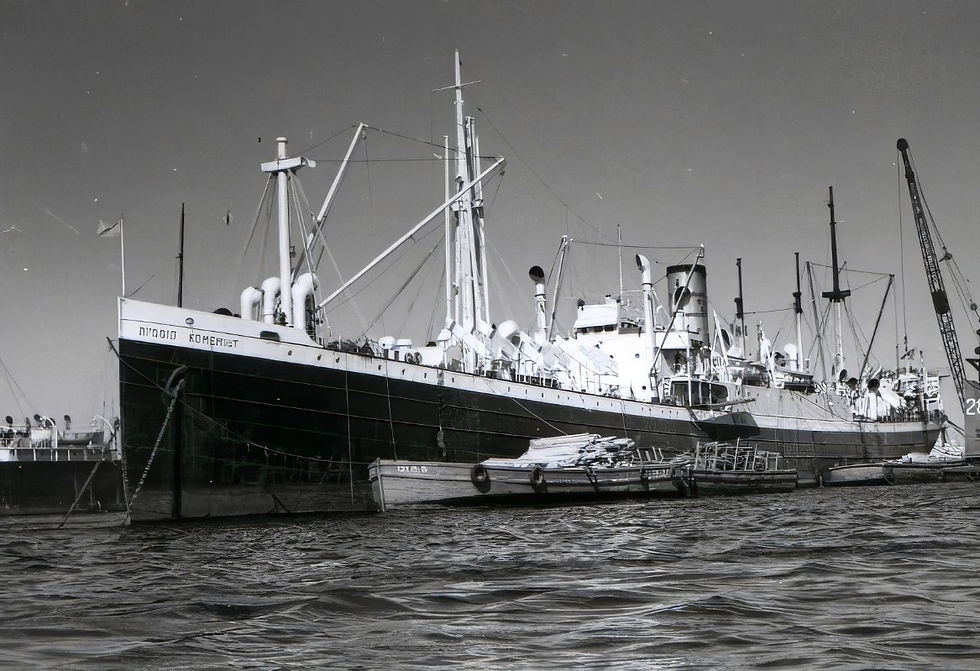
The "Pan Crescent" and "Pan York" (renamed Atzma'ut and Komeimiut) were the two largest ships in the history of illegal immigration to Palestine.
We rode three days and three nights together out of Germany and into Marsae [typist's spelling], standing on an open truck until we got there. And then we boarded the ship called the Pan York. Later on, it was renamed the Independence, and it is also one of the five ships you will see on a plaque in the Smithsonian Institute. That trip was more horrendous than the one we made during the British mandate because the United Nations then was waiting at Haifa Harbor, and we were not supposed to be on that ship either. And because of what happened next, I met my husband, who saved my life.
I'm a little fuzzy on dates, but I remember the date that we tried to get into Haifa. It was July 17, 1947. We were finally taken back to Germany and beaten off the ship on September 8, 1947. It was not so long. That whole trial was just about ten weeks. There were four camps that they took us to set up outside of Munich. I knew very, very little Yiddish because Yiddish was, you know, the international language. But even when I went to Israel and met Aaron, my husband, somehow I learned to communicate. With human beings, you can share; it isn't always the same language. The Pan York was a real Tower of Babel because we had people from Romania from Morocco. It had a different crew and passengers than we had on the Exodus.
In the Exodus, people were from a displaced person camp. But when we went on the Pan York, people were running away from Romania, Hungary, as all those countries no longer had any reason for living there. They also were stateless. They asked for my name and registration, so I registered as Hava Sakowski. Years later, I wanted to have proof that I had been on that ship. I went looking for it in Jerusalem in a dusty old building, and sure enough, I found the files they kept, and yes, I found my ship and my name. I was able to go with it to the minister of immigration and declare myself. This process was how I could later get back to the states to visit my parents.”
Aaron Friedman
From Ben-Gurion backer to Israeli beachgoer, Aaron Friedman has made a life of saving others. A dapper man when wearing his signature safari-style hat, 90-year-old Aaron Friedman becomes exuberant when he shares his tales of being David Ben-Gurion's bodyguard. He is a confidant of Yitzhak Shamir, and he enjoys the fame he acquired while being a lifeguard on the beaches of Tel Aviv. He has many stories of how he has dedicated his life to helping the Jewish people and humanity — it just so happens that many came at critical moments in the birth of the State of Israel.

Aaron Friedman, a founding hero of the State of Israel, died Jan. 6, 2021, at the age of 96 in the Los Angeles area, where he lived for many years. Friedman helped to smuggle Jewish refugees from Europe to Palestine during the British mandate when immigration was banned.
Currently living in Reseda, he was born in Jaffa in 1924 as Menachem Aaron Friedman. He lived at the edge of the sea in a shanty house that his father built from driftwood. "I love the sea! We were so poor that my father and I would offer fish that we caught with our bare hands to the neighbors for Shabbat dinner before going to school," recalls Friedman. He would walk by the house of Ben-Gurion, the future prime minister, on the way to school.
Early in his life, Friedman became acutely aware of the plight of Jews in Palestine. "At the age of 5, I became an adult overnight," Friedman said. "I heard that the entire community of Hebron was slaughtered [during the Pogrom of 1929], and I took on the responsibility to protect the Jewish people."

The Hebron massacre refers to the killing of sixty-seven or sixty-nine Jews on 24 August 1929 in Hebron, then part of Mandatory Palestine, by Arabs incite to violence by rumors that Jews were planning to seize control of the Temple Mount in Jerusalem.
As a young teen, Friedman wanted to be a lifeguard but wasn't old enough, so he contrived his age. This wouldn't be the only time he refused to let his age get in the way of something he wanted.
At the age of 15, Friedman became a legendary lifeguard on the beaches of Tel Aviv. It was when the beaches were the hub of the social scene, and Friedman enjoyed his rock-star status. With a physique reminiscent of Jack LaLanne, he had many people vying for his attention and friendship, including several people who would later become prime minister. "Golda Meir would stop by to talk," Friedman recalled, "and Yitzhak Shamir — we were Friday night drinking buddies." He also became friends with Ariel Sharon. "I saved more than 800 people, Danya Weizmann, a sister of Chaim Weizmann [the first president of Israel], and I still have his letter of thank you!"
When he was 16, Friedman again adapted his age to fulfill his dream of becoming a soldier. He served in the Jewish Settlement Police, whose purpose was to protect Jewish settlements from Arab guerillas.
It's easy to become transfixed when Friedman tells story after story, bringing history to life — especially when he recounted one infamous day in 1941: "The British were desperate that they were going to lose the Middle East and the gate to India — the Suez Canal. Ben-Gurion gave the order to [Moshe] Dayan, who was in charge of the land troop, to dynamite a few bridges and roadways so that there would be no access. We were on the northern part of the Golan Heights, on the border of Syria, when we encountered a small group of [foreign] advisers to the Syrians, and there was a little skirmish. A bullet grazed Dayan's eye — there was lots of blood, and it looked awful, but Dayan just said, "Al Kol b'seder" — everything was all right. Somehow we escaped and rushed him eventually to Tiberius, but they couldn't save his eye — and that's the true story of how he lost his eye."
Yaakov Dori, the chief of staff of the Hagenah, appointed Friedman in 1946 to be the personal bodyguard of Ben-Gurion, who was then the chairman of the Jewish Agency. Friedman's connections with various militias — especially Etzel and Lehi — and knowing Ben-Gurion since his childhood got him the position. "I was one of six bodyguards, and my job was to be attached to him day and night. I protected him not from the Arabs but the friction with the militias. There was always danger," Friedman said. "My admiration for him was because he was a Jew uniter — it didn't matter if you were from the left or the right, ultra-Orthodox, Conservative. He was a leader who took command, and he wanted land for the Jewish people."\

Yaakov Dori was the first Chief of Staff of the Israel Defense Forces. He was also the President of the Technion – Israel Institute of Technology.
Friedman wasn't merely in the shadow of giants of the Jewish state; he was also part of making history. "It wasn't until about ten years ago that I learned the full depth of what he was involved in," said Gregg Alpert, national director of eLearning at the Hebrew Union College-Jewish Institute of Religion. He was 14 when he met Friedman through the United Synagogue Youth (USY). "It turns out that Friedman was an operative who was sent into Cypress refugee camps to smuggle people to Israel. So it wasn't just that he was David Ben-Gurion's bodyguard, but he also had an active hand in shaping the history of the Jewish people."
Friedman's desire to save people also led to meeting his wife, Esther Shawmut, a Jewish-American pharmacist's mate in the Navy. In 1948, she was on board the Pan York, a refugee ship being searched in the Haifa harbor for non-disabled, military-age people who were not allowed to enter the country. Shawmut, along with others, jumped ship to swim to shore. But she didn't know how to swim well and got caught in the riptides. One of the Israeli combat divers rescuing the volunteers, Friedman, pulled her safely ashore. "I told her my name, and she never forgot it," Friedman said.
Friedman and Shawmut married in 1954. Soon after that, Friedman recalled, Ben-Gurion approached him and said, "I want you to go to the United States. It's like what I did before World War II went to Canada, the United States and helped liberate Palestine. I had a vision, and you can do it too. I want you to inspire the youth and tell them the story of Israel; that is your next mission."
Friedman and his wife went to the United States that same year, first to Miami, where he taught swimming at a small private school. In the years that followed, they had one daughter, Shari Lesnick. They were the founders and directors of Camp David in Luzerne County, Penn., in the early 1960s. In 1964, Friedman was appointed youth director of USY for the Pacific Southwest Region and moved to Sherman Oaks. He built up the organization for ten years, which had started with approximately 15 chapters. Meanwhile, Shawmut Friedman was the Southern California regional executive director of the Zionist Organization of America and director of BBYO (formerly B'nai B'rith Youth Organization).

B'nai B'rith Youth Organization (BBYO) is an international "trans-denominational" Jewish youth organization. Early chapters were formed in the U.S. in the 1920s.
The couple worked together as an influential duo to create a passion for being Jewish and sharing the spirit of the State of Israel. Their dedication to youth infused their entire adult experience. "Great people inspired me. I don't like politics. I focused on the children, who are the future leaders of humanity. I try to teach with kindness and gentleness — anger brings you nowhere," Friedman said. Their honeymoon lasted nearly 60 years until Shawmut Friedman passed away in March 2013.
Today, Friedman is 90 percent blind in one eye and is losing his sight in the other eye. He's still vivacious and continues lecturing and sharing his stories. "I am a small pebble in Jewish history," he said. "The past is for historians, the present is for the living, and the future is for humanity to improve what we have. We have a land and a country — there's a bright future."

Comments