
Sleepless Night to Eternity
- Max Cardozo
- Jul 26, 2021
- 15 min read
Updated: Jul 28, 2021

Throughout history, we have seen brave people who were willing to stand up to their oppressors and fight against them. Who better to face the greatest evil of the 20th century than the humble RIGHTEOUS AMONG THE NATIONS. Many of these heroes are honored at the Holocaust martyrs and heroes' remembrance at Yad Vashem: World Holocaust Center, Jerusalem.

Cardozo rescuers at the time of the Holocaust were Righteous Among the Nations:
Gils van Bertha (1908 - 1974)
Ledeboer Paulina (1905 - 1996)
Koning Geertruida (1917 - 2007)
Geest van de Jannetje (1895 - 1976)
Koopman Cornelia (1898 - 1983)
Broers Maria (1914 - ?)
Diepen van Agatha (1912 - 1997)
Keijzer Trijntje (1893 - 1969)
Broers Anna (1905 - 1976)
Geest van de Cornelis (1896 - 1976)
Alta Johannes (1916 - ?)
Gils van Adrianus (1910 - ?)
Koning Theodorus (1913 - 2010)
Broers Adrianus (1906 - 1976)
Broers Joannes (1910 - 1983)
Diepen van Petrus (1908 - 1987)
Koopman Cornelis (1895 - 1960)
Keijzer Reijer (1892 - 1986)
My success is due to two significant people, my wife Lenore of many years, and my G-D every Friday night does the blessing for candle lighting, covers your eyes with your, and recites the appropriate prayer.

And by claiming—and demonstrating—that everyone is equal before G-D, they inspired their followers "to reach out in love —and without fear"—to all kinds of people.
New Year's Day 1942 Came on a Thursday
Papa came home early on Wednesday, the last day of 1941, bearing wine, cigars, party masks, and a couple of those empty fruit crates I liked to use as sleds in the snow. My Mama was busy in the kitchen, making special oliebollen (doughnut balls) and apple turnovers.
We waited until dark on New Year's Eve, and then at about five o'clock, we set out on foot for the New Year's party at Aunt Jansje's place. Papa and Mama were carrying the fruit crates loaded with goodies. Papa was constantly looking around. He was watching out for NSB-ers. The NSB, or NationaalSocialistische Beweging, was the Dutch Nazi Party. In their zeal, the younger NSB-ers would start trouble with Jews in the street to make a name for themselves. They were so brainwashed by their elders, so proud to be "Aryan," that some of them would love to be part of our extermination. There was a real danger from the NSB and its sympathizers in Holland.
The anti-Semitic feeling was quite familiar among the Dutch at the time. The mass of anti-Jewish propaganda was overwhelming. And if you were a Jew in Holland, you could count on no help from the police. Most of the police were puppets of the Nazis. They would ride around proudly on their motorcycles and sidecars or black bicycles with gun holsters on the frames—but they would never interfere with the NSB.
So, although I was too young to understand it, our merely being on the street that night put us in peril. If our family were to be accosted by a violent NSB youth gang, we'd be entirely on our own. If you lived in the western or southern parts of the city, you were not hit as severely as in the old Jewish section. But Papa knew we were next. Fortunately, it was usually possible to guess if someone you knew was related to the NSB, and so far, our immediate neighbors didn't seem interested in sympathizing with the Nazis. But these were strange days, and strange things could happen.
It hadn't been so bad in the early years of the occupation. The Nazis were very careful to pass their anti-Jewish regulations one by one, little by little—so that most Jews were inclined to think, well, I survived the last insult, I guess I can deal with this one, too. But within the coming year, 1942, the Dutch Jews were dismissed from every remaining sphere of social and economic life, left with no income and little possible help from their relatives. Then, at last, we would be cordially invited to the railway station to experience the final insult. But on the evening of December 31, 1941, I didn't know that yet. I was still two weeks away from my fifth birthday.
We walked with a quick step in the winter night. Mama and Papa were both fast walkers. Flip and Jansje, my Aunt and uncle, lived in a lovely apartment in the Zuider Amstellaan (known today as Rooseveltlaan), and this was just a few blocks from where we lived—but for me, it proved quite a trek. My leather shoes with leather soles kept me warm, but soon I ended up riding on Papa's shoulders. Papa was a strong man.
We all walked to the apartment of my Aunt and uncle, Flip and Jansje Gompers, for their spectacular party. When we arrived at our destination, little Maxje was already cold and tired. Aunt Jansje opened the door to her flat and beckoned us into the warmth and light.
This room was gigantic! I don't think I'd ever seen such a splendid apartment. This one-room alone seemed to be forty feet long, and it had two long tables set out for our celebration. In Holland, New Year's Eve is called "Old Year's Eve," or Ouderjaars Avond. To this day, I can remember that party—the smells, the tastes, the faces, the songs, as if it were all still happening. I guess there's a good reason for that. And so many people! Many of my relatives were there, all in one place, from the Gompers and the Noach families.
I saw my uncles Alphons and Ams Noach, their mother Caroline Noach, her brother Louis Napol, their daughter Nellie, Jansje's sister Aunt Juliette, and Uncle Ab. And finally, there was Uncle Flip— my uncle Philip Gompers— who always pinched my cheeks, who were friends of Jansje and Flip.
Pretty soon, the party was in full swing. And as the night burned on, even more people showed up. Oh, boy, did it stink of cigar smoke! The Noach were good singers; somebody played the violin; somebody else played the accordion.
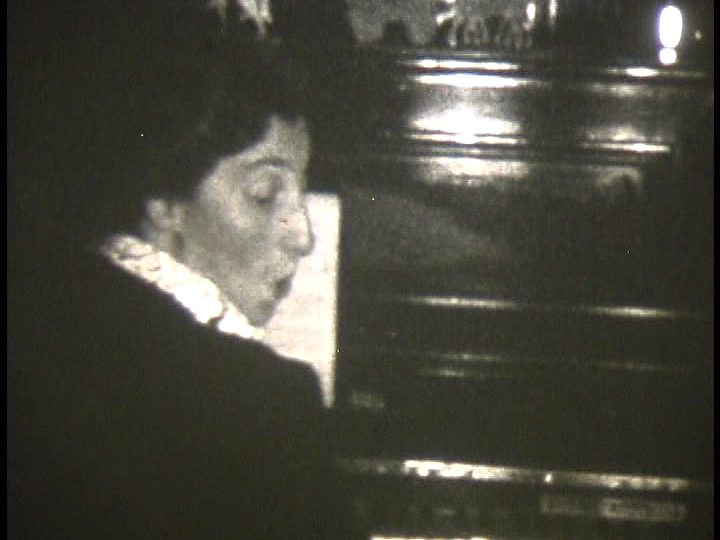
And my Mama played the piano. Mama was in a beautiful mood that night. It was as if she had no idea what the future would bring. "Boys," she said, "tonight we are not going to mourn; let's forget all our problems tonight."

Everyone loved my Mama. She always had a way to make someone's heart feel good. She would look at a sad person, call out their name, and say something—spontaneously make up a rhyme—to pull them out of their sadness. Tonight, Mama's piano-playing had such a swinging rhythm that some people couldn't help but start dancing. They danced in a circle, holding each other by the shoulders. Music always creates that feeling of welcome—Shalom! — the feeling that there will soon be peace around the world. And if this small, musical crowd couldn't solve all the world's woes, in the meantime, they could at least raise a smile. Still, even at my age, I could see a sort of misery there, in all their fond faces, hidden just under the surface.
My Papa was not entirely so outgoing in these situations—he left that up to Mama. He was the kind of fellow who would measure someone's character by shaking hands. And as I say, he was a strong man. My uncles would shake his hand and wince, "Not so hard!" Some people were afraid to shake his hand— but then, just being around him gave them a kind of safe feeling.
Mama loved Amsterdam. She was a real Amsterdammer. Papa was more of a country lover and an athlete. He never could sit for long. But when the musicians played Yiddish songs, you could see tears in Papa's eyes—mainly when they played the song "Yiddish Mama." Papa was crazy about his mother—and so was I. Oma Betje was one of my favorite people in the world.
All the grown-ups were busy setting out the wine, the kroketten (Dutch egg rolls), the honey cakes, the butter cakes, the oliebollen, and the turnovers.
What was so rich about that night was the happiness I felt with my family. The sheer joy of being together in troubled times, the feeling of being surrounded by the hostility on the outside— that is what glued us to that table. The trust, the family, and the friends all formed what seemed an unbreakable bond with our Amsterdam Jewish tradition.
As the evening wore on, I was retired to my cousin's bedroom, where my baby cousin Ernest lay weeping in his new crib—my old crib. I listened from there, sometimes peeking out, while the grown-ups talked and talked.
Debates began to spring up about how to deal with the mounting terror toward the Jews. My Papa had strong opinions, and he defended them vehemently. He said, "The signs are everywhere; there's no chance that we are all going to come out of this alive."
Uncle Flip countered that the Jews needed to have confidence in the Jewish Council. What better choice did we have? He reminded everyone that this was his house, and he asked Mama to try and quiet Papa down. But once Papa set his mind to something, nobody could talk him out of it. Papa argued that today the question was of survival and freedom. How could we remain free? What tactics could we use? What about the NSB and their youth gangs?
Life for the Jews was not only dreadful—it was boring, too! Almost all Jews had been dismissed from their jobs, and those practicing an independent profession were so handicapped that it was nearly impossible to make a living income.
Papa said he had no confidence in any banking institutions. He had buried some of his valuables in the ground, in a metal box in a secret location.

The Gompers, who had been diamond cutters for well over 100 years, was a well-established family, and they tended to view things more optimistically than my father did.
There were a lot of questions and a lot of answers at that New Year's table. Papa and Uncle Flip and Uncle Ab kept going around and around—until finally, Mama could take no more. She stepped right up on a chair, in her black chiffon dress and white-collar, and began to sing—and insisted everyone sing along.
I was listening to all this from the bedroom of my little cousin Ernest. I was scared. My Aunt Jansje was a hat-maker and used that bedroom as a hat factory. All the wooden blocks for hat-making reminded me of so many skulls, and there were bird feathers, and lots of foul-smelling felt for the hats. I didn't understand what it all was, and it frightened me.
Then, we saw flashes of light and heard bombs falling in the distance, and Ernest would cry. But what scared me the most was listening to the men out there arguing with my Papa about politics. Just then, the clock struck midnight. “Gelukkige Nieuwjaar!” they shouted. Happy New Year!
I was thrilled when Mama came to get me from Ernest's bedroom Aunt Jansje picked up Ernest, and Mama carried me to the crowded table, where everyone wished us, “God Bless”. My elders wished me well, and that I should be strong, and that we should have the fondest dreams. And my Aunts and uncles tried to keep on singing.
On the first few mornings of that new year, Papa pulled me around in the snow on my wooden sled. Mama would always make us a hot lunch, sometimes with Aunt Caroline for company. Thursday, it might be fish; Friday, chicken; Monday, leftovers—along with apple or pear cakes. Always something good.
On Friday evenings, Papa brought flowers home for Mama for the Shabbat. He never neglected to do this, despite the bitter cold.
Some afternoons, I would sit in the front of our first-floor bay window, eating sandwiches with candy sprinkles or chocolate chips, watching some house on our street slowly being emptied of its contents. I was curious about all those ropes and big metal hooks used for furniture moving. Unlike American cities, in Amsterdam, the stairs are too steep and narrow to be used for moving anything significant, so large items need to be hoisted in and out of the front windows, with hooks and overhead winches. So, in Holland, moving furniture becomes more of a theatrical spectacle.
At night, Papa would show me how to build houses out of playing cards. He would tell me stories and gently nudge my bed to rock me to sleep. With a kiss on the forehead, he'd wish me God Bless and a healthy rise.
One evening, things would change. It was pouring rain at eight o'clock that evening; the streets had turned icy—and Papa was still not home. Mama and I were desperately worried. Finally, we heard a soft whistle from outside. Mama ran to the door and waited for the quiet knock. Then, she pulled the rope that opened the downstairs door.
Papa, who usually ran right up the stairs, came shuffling up slowly this time—looking more depressed than I'd ever seen him before. Mama put her arms around him, and they both went to the front room. Without a word, Papa fell flat on the couch. He was shaking terribly; he was cold and wet all over; his feet and socks were wet, and he'd lost his tweed cap and knit gloves. Mama was worried that he had a fever—but he did not have an elevated temperature.
I went back to my bed and started thinking about how I was almost five years old, how Papa was thirty-five, and how much love he gave us—me, Ido, and Mama. And now, it felt as if some monster out there in the cold dark was trying to forbid that love. It was trying to destroy that love by not letting us listen to the radio, sit at the sidewalk cafés, or laugh in movie theaters.
Now I could no longer visit friends to celebrate Hanukkah. There would be no more sitting in Papa's automobile, as Jews were no longer allowed to use cars. And when we would go to the butcher, the baker, or the greengrocer, they were not so happy to see us anymore, and we'd usually end up with the worst of what they had in the shop. Nowadays, for some reason, we even had to keep looking over our shoulders, lest we encounter unkind people in the street. It was like the story Mama used to read me, of the Big Bad Wolf looking for Little Red Riding Hood to have her for supper.
Papa had gotten an injection to raise his blood pressure so as not to be sent to a Nazi work camp. After the injection, Mama fed Papa some hot soup but said he was silent. Papa had always been a proud man, well-liked by all his friends and admired for his determination in everything he did. But now, here was Papa, looking sick, degraded, humiliated.
And I, at almost age five, was suddenly wondering what our household would do without him— even though I knew Mama was a good mother.
My parents had been married for six years, and because of that monster outside, those years had been very depressing years. Papa was supporting not just our own family, but his mother, too—my beloved Oma Betje—and now he could see his means of earning a living eroding like a beach sand underfoot. It was little wonder he felt completely overwhelmed. I could not read or write yet, but I could read in his eyes.
Things were quiet, and after a while, I dozed off. I dreamed that I saw a kind of siren-like monster standing on a pedestal before my bed, confronting me. It looked like one of the iron characters in The Wizard of Oz. I started to scream as Mama and Papa came rushing to my side. Mama lifted me in her arms. Papa went to the kitchen to get a cold washcloth to put on my head.
It must have been about eleven at night. After ten minutes, they had calmed me down somewhat. Papa prepared a cup of water, opened an aspirin packet, stirred the contents in with a spoon, and made me drink it. It was horrible—a bitter taste and powder all between my teeth. But it must have done its work because soon after that, Mama and Papa were tucking me into sleep again.
The following day, I heard my parents talking at breakfast. Papa said that people out there were being crowded into ghettos, picked up in the street or dragged from their houses, and shipped away to labor camps in places like Vught and Amersfoort. He said some people had been packed off and transferred to another center called Westerbork.

Papa explained that to stay out of the labor camps; he had to make himself appear unfit for work. So, through a relative of ours, he had found a sympathetic doctor in the town of Hoorn. This doctor had injected Papa with medicine that made his blood pressure read very high for a few days. That way, when he went for his regular physical exam to keep his medical card up to date, he would appear very unhealthy—indeed no suitable for the labor camps—and the authorities would note this on his persoonsbewijs, or personal I.D. card. But the side effects were very unpleasant. It gave him a miserable fever and chills.
The night before, he'd gone to visit Oma Betje at her home in the Louis Boterstraat. On his way home, he'd seen a gang of Black Shirts—a semi-military organization of the NSB—marching provocatively through the Jewish neighborhood. Massive fights had broken out. The Germans had raised some of the drawbridges to the south to close off the area. Many Jews had been arrested. Papa said he had been blessed to escape and eventually make it home that night.
"All the time," he said, "I was thinking of your Mama and the two of you and what would happen with you boys."
Just a few days later, Sunday, January 11, was my birthday. Papa came home very early that day, carrying something up the stairs.
A bicycle! When I saw Papa coming up the stairs with that bike, I was so happy; no sooner could he set it down than I hugged him with all my might then, I hugged Mama.


My new bike had big red blocks on its pedals to reach them with my feet, and Papa adjusted the handlebars as low as they would go. Well, I soon found out how difficult it was to ride a bicycle. There were movers' ropes all over the tiled sidewalks on the Waalstraat. Papa tried everything to coach me, but I complained about how hard it was and how cold I was.
That Sunday, I was happy because Papa got my sled out of the closet in the back of the rear balcony. Our balcony closet connected to our neighbor—an architectural feature that would later play an essential role for us.
I liked snow for two reasons. First, I wanted to play in the snow with my sled. Second, I had noticed that if the snow were falling, there would be no air raid sirens or explosions. The bombers didn't fly in bad weather.
Sometimes, during that January, cars with great big gray loudspeakers would show up in our neighborhood, warning of unexploded English bombs, proclaiming that the whole area had to be evacuated so the bombs could be removed and detonated outside the city.
These loudspeaker vehicles also took the opportunity to blare Nazi propaganda, warning our neighbors that it was us—the shiftless, disease-carrying Jews—who were responsible for bringing these English bombers over Amsterdam in the first place. Whenever these monster-wagons came by, Mama would pull me away from the front window, take me in her arms, and start telling me stories—about music, or animals, or whatever—anything to distract me from the spectacle outside.
Those cars were just as scary to me as the nightly bombings. It wasn't so much the messages themselves, but their screaming—how they screamed, never talked, always shouted and railed. I came from a family who tried to speak calmly, and Mama and Papa never raised their voices like that. We even got punished with soap in our mouths if we said something terrible.
Papa and Mama were, I think, very civilized and good people, always ready to help anyone. Papa, especially, tried to be good to everybody, Jew and non-Jew alike. Later, this goodness of his would fold back in upon us and help save our lives.
Even though we were not permitted to own a wireless set, Papa hid one under the staircase and would sometimes listen to the broadcasts from London, where the Dutch government lived in exile. Papa had a copper wire strung up as a clothesline at the back of our balcony, and this was his antenna. We boys were usually not allowed to listen, but sometimes Mr. Noah came over. At my age, I had no idea what they were listening to. They would sit around the radio listening to the news, but I was usually in bed at the time.
Papa and Mama had a gramophone, the kind you had to wind up. They loved music and loved to sing and dance—and of course, Mama often played the piano. We had our black upright piano in our flat. Even with all the troubles, she insisted on keeping up hope.
Early in February, I developed problems with my tonsils. The sleepless nights, the cold weather, and the endless hours spent huddling in the hallway waiting for a bomb to drop on our building—I think the terror of it all was beginning to wear down my health. I had a very sore throat, fever, chills, an ear infection, but most of all, my throat was killing me.
Mama, who acted as the doctor in our house in many ways, told me that I had bad breath and that most likely, my tonsils would have to be removed. A week or so went by. By February 10, I still had a fever and terrible pain in my ears and throat. So, Mama took me to a doctor friend of my uncle Ams Noah, and he recommended a tonsillectomy.
The doctor started to prepare me for the operation. Mama discussed the surgery frankly with me, explaining that what the doctor would do would make me healthy again. She held my hand and provided great reassurance throughout the ordeal. Uncle Ams' family, friends, and doctor were also accommodating in talking to me. About four hours later, I was adequately recovered and released for Mama to take me home.
The next day, Mama spoiled me with milk, honey, sugar, raw eggs, and lots of sugar water and puddings. Before long, I recovered. But I never did like having the doctor take those throat cultures where I had to say, "Ahh."
As winter wore on toward the spring of 1942, I became aware of some of my parents' more unusual activities. Papa had been a friend of a member of an organization called the Ordedienst. The word means "order service," the body of people responsible for keeping order. This organization had been formed back in 1918, mostly from retired military and civil guards, to protect against the possibility of a political revolution. But during the Nazi occupation of Holland, the Dutch resistance movement needed an existing organization to build on—and the Ordedienst, or O.D., was the ideal vehicle.

Comments